Redevelopment has become a necessity for thousands of aging cooperative housing societies across Mumbai, Thane, Pune, Navi Mumbai, and other parts of Maharashtra. However, one of the biggest practical challenges faced by large societies is ensuring the required quorum when many members live outside the city or even outside India.
Many societies therefore explore alternatives such as e-voting, online participation, consent letters, or mock voting to select a redevelopment developer. But are these methods legally valid? The answer lies in the Government Resolution (GR) dated 4 July 2019, popularly known as the 79A Redevelopment Guidelines.
What Do the 79A Redevelopment Guidelines Provide?
The redevelopment process for cooperative housing societies in Maharashtra is governed by the Government Resolution dated 4 July 2019, issued under Section 79A of the Maharashtra Cooperative Societies (MCS) Act, 1960.
These guidelines prescribe the complete redevelopment procedure, including:
- Appointment of the Project Management Consultant (PMC)
- Calling the Special General Body Meeting (SGM)
- Invitation of bids from developers
- Presentation by shortlisted developers
- Selection of the developer
- Execution of redevelopment documents
Although courts have clarified that these guidelines are directory and not mandatory, societies are still expected to substantially comply with them. Minor procedural deviations may not invalidate redevelopment, but ignoring the core requirements can lead to disputes and legal challenges.
Why Is Quorum a Major Challenge?
The 79A Guidelines require a minimum quorum of two-thirds of the total members for the Special General Body Meeting where the developer is selected.
For large societies, achieving this quorum is often difficult because:
- Many members reside abroad.
- Some members live in different cities.
- Senior citizens may be unable to attend.
- Members may be bedridden or unavailable.
Despite these practical difficulties, the current legal framework has not relaxed the quorum requirement.
Is E-Voting Allowed for Builder Selection?
No.
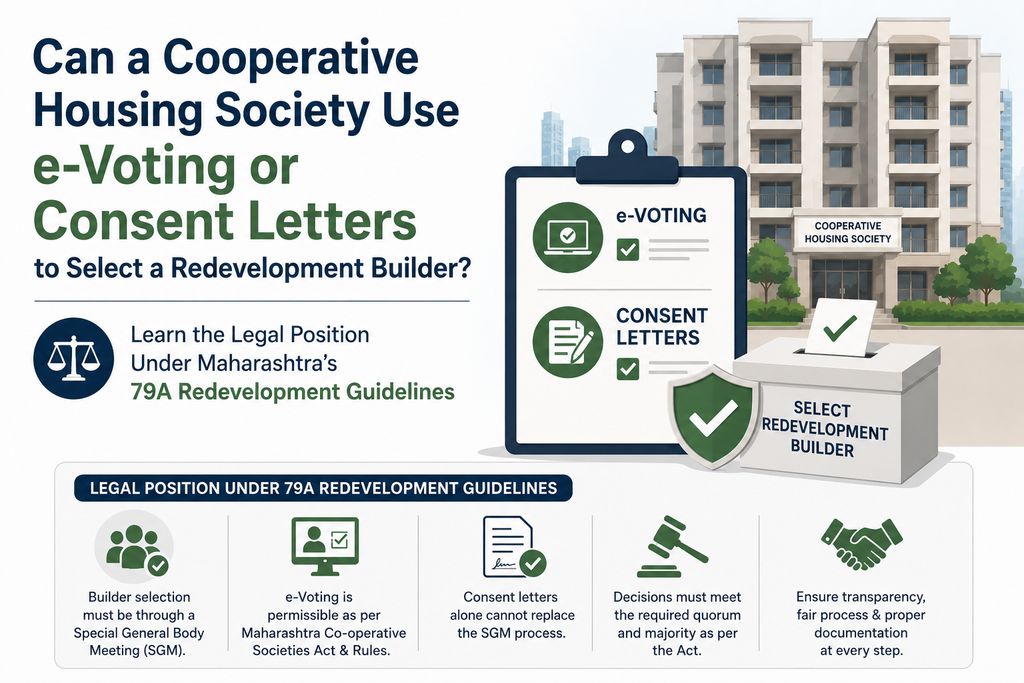
At present, the 79A Redevelopment Guidelines do not permit e-voting or online voting for selecting a redevelopment developer.
Only members physically present at the Special General Body Meeting are entitled to cast their votes.
This means that:
- Members living abroad cannot vote online.
- Members outside Mumbai or Maharashtra cannot vote remotely.
- Virtual attendance is presently not recognised for developer selection.
Until the Government amends the guidelines, physical voting remains the only legally recognised method.
Can Consent Letters Replace Physical Voting?
No.
Some societies attempt to collect consent letters or written approvals from members who cannot attend the meeting.
However, the present redevelopment guidelines do not recognise consent letters as a substitute for voting during the Special General Body Meeting.
Developer selection must take place through voting by members who are physically present at the meeting after discussions and presentations.
Therefore, obtaining 51% consent letters outside the meeting cannot legally replace the prescribed voting process.
What Is Mock Voting?
Many societies conduct mock voting before the final developer selection.
The purpose is generally to:
- Assess members’ preferences.
- Shortlist developers.
- Estimate likely voting patterns.
- Help developers understand member support.
However, mock voting has no statutory recognition under the redevelopment guidelines.
Does Mock Voting Have Any Legal Value?
No.
The concept of mock voting does not appear anywhere in the 79A Guidelines.
It is neither prescribed nor recognised under the Government Resolution governing redevelopment.
Therefore:
- Mock voting is only an informal exercise.
- It cannot bind the society.
- It cannot determine the final developer.
- It cannot replace the legally prescribed voting process.
Ultimately, only the voting conducted during the Special General Body Meeting has legal significance.
Can Members Change Their Decision During Final Voting?
Yes.
Since mock voting has no legal sanctity, every eligible member remains free to change their choice during the actual Special General Body Meeting.
Members may alter their preference after:
- Hearing developers’ presentations.
- Studying financial offers.
- Understanding redevelopment terms.
- Asking questions during the meeting.
- Considering additional information.
The final vote alone determines the selection of the developer.
Are the 79A Guidelines Mandatory?
Several judicial decisions have clarified that the 79A Guidelines are directory rather than mandatory.
This means:
- Substantial compliance is expected.
- Minor procedural lapses may not invalidate redevelopment.
- Core principles such as transparency, fairness, and member participation must still be followed.
Societies should therefore avoid shortcuts that may invite litigation later.
Need for E-Voting in Redevelopment
Considering technological advancements and the growing number of non-resident members, many experts and housing federations have recommended introducing:
- Secure e-voting.
- Video participation.
- Online attendance.
- Digital verification of members.
Such reforms would enable greater member participation while maintaining transparency and reducing delays in redevelopment projects.
Until the law is amended, however, societies must continue to follow the existing physical voting procedure.
Key Takeaways
- E-voting is currently not permitted for selecting a redevelopment developer under the 79A Guidelines.
- Only members physically present at the Special General Body Meeting can vote.
- Consent letters cannot substitute physical voting or create a valid majority.
- Mock voting has no legal recognition and is merely an informal exercise.
- Members are free to change their choice during the final legally conducted voting process.
- Societies should ensure substantial compliance with the 79A Guidelines to avoid future legal disputes.
Conclusion
Selecting a redevelopment developer is one of the most important decisions a cooperative housing society makes. Although practical challenges exist due to members residing outside the city or abroad, the current legal framework requires physical participation for voting. Until the Maharashtra Government introduces provisions for secure e-voting or hybrid meetings, societies must strictly follow the existing procedure under the 79A Redevelopment Guidelines to ensure the redevelopment process remains legally valid and transparent.