
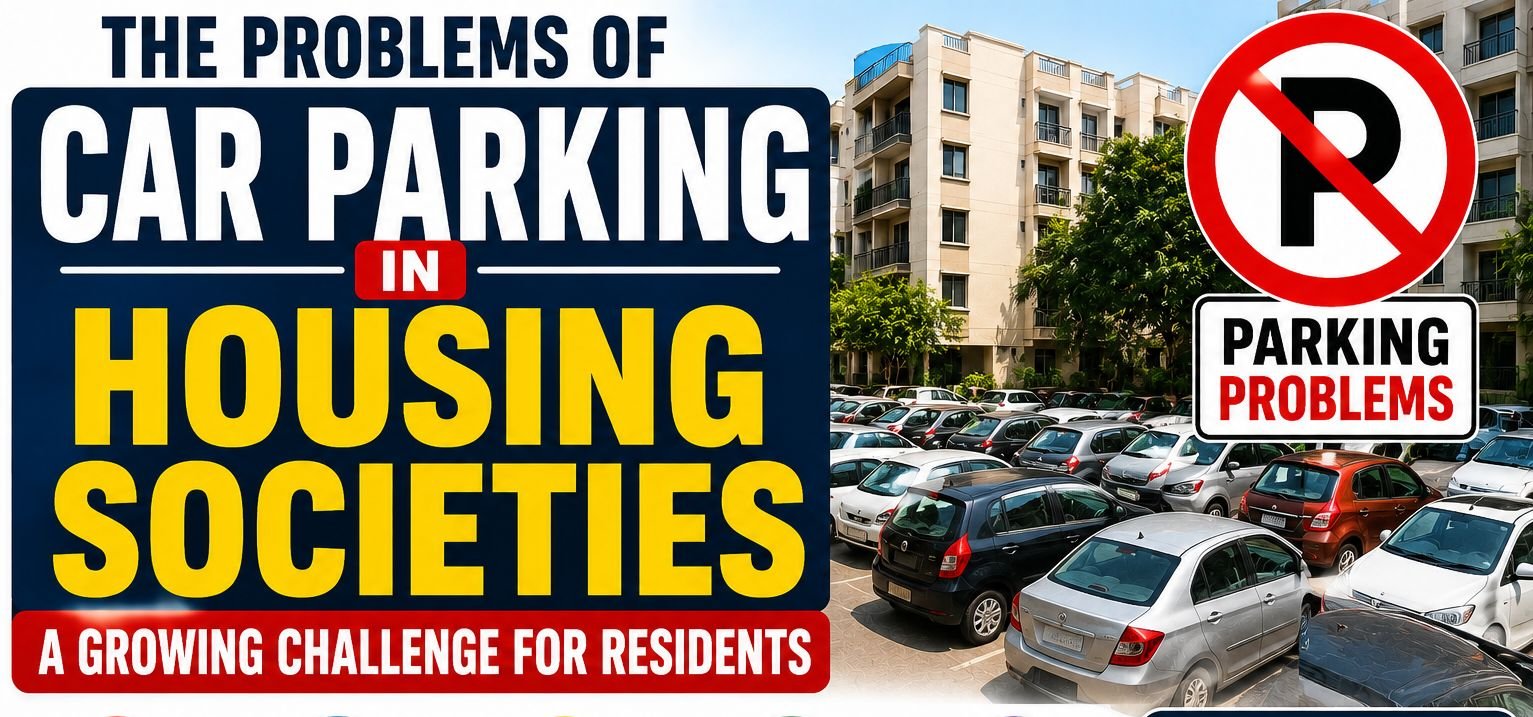
Car parking has become one of the most contentious issues in cooperative housing societies. With the number of private vehicles increasing rapidly and available parking space remaining limited, disputes frequently arise between members, tenants, builders and managing committees.
Questions relating to parking are not merely administrative. They involve the Maharashtra Cooperative Societies Act, society bye-laws, municipal regulations, sanctioned building plans and the legal rights attached to flats and common areas.
A number of practical questions arise:
- Does a tenant have a right to park a vehicle in the society compound?
- Can a member of a cooperative housing society demand a parking space?
- Can a builder sell or allot an open parking space?
- Can a society allot more than one parking space to a member?
- Can the general body impose parking charges?
- Can parking areas be converted into shops or other premises?
- Does purchasing a flat automatically confer a right to park a car?
- What happens when the builder fails to register the society or execute conveyance?
These questions have to be examined in the context of the applicable law and the sanctioned layout, rather than merely on the basis of a resolution passed by the managing committee.
1. Parking Is a Major Housing Society Issue
In densely populated cities such as Mumbai, parking space is scarce and therefore extremely valuable.
A society may have dozens or even hundreds of flats but only a limited number of permissible parking spaces. This creates disputes when:
- one member owns multiple cars;
- members demand more than one parking space;
- tenants seek parking facilities;
- visitors occupy members’ parking;
- builders attempt to sell parking spaces;
- parking areas are converted for other purposes; or
- members claim exclusive rights over common areas.
The solution cannot be to permit unrestricted parking merely because the society has vacant space.
The number, location and nature of parking spaces must comply with the sanctioned plan and applicable development regulations.
2. Does a Flat Owner Automatically Have a Right to Park a Car?
Ownership of a flat and entitlement to a particular parking space are not necessarily the same thing.
A member may have the right to use the common areas and facilities of the society in accordance with the applicable law and bye-laws. However, that does not automatically mean that the member can claim an exclusive parking space wherever he or she chooses.
Parking arrangements have to be made by the society in accordance with:
- the sanctioned building plan;
- applicable municipal regulations;
- development control regulations;
- society bye-laws; and
- resolutions of the competent general body.
The society therefore has to maintain an orderly and legally compliant parking system.
3. Can the Society Permit Unlimited Cars?
No.
A society cannot simply allow every member to park multiple vehicles merely because some open area is available.
Parking areas are subject to the sanctioned plan and development regulations. If an area has been earmarked for a garden, recreation, access, fire tender movement or another approved purpose, it cannot ordinarily be converted into unrestricted parking merely through a society resolution.
This is particularly important in cases where members attempt to park vehicles in:
- garden areas;
- playgrounds;
- access roads;
- fire access areas;
- entrance and exit passages;
- areas reserved for recreational use; or
- other spaces not sanctioned for parking.
A society resolution cannot override municipal planning requirements.
4. Role of the General Body in Parking Allotment
The general body has an important role in determining the society’s parking policy, subject to the law.
The society may formulate a system dealing with:
- allotment of available parking spaces;
- parking charges;
- eligibility;
- rotation of parking;
- renewal or re-allotment;
- visitor parking;
- use of additional vehicles; and
- consequences of unauthorised parking.
However, the general body must operate within the limits of the sanctioned plan, development regulations and applicable statutory provisions.
A resolution cannot legalise an otherwise unauthorised use of the premises.
5. Can the Society Charge for Parking?
Yes, subject to the applicable bye-laws and the decision of the competent authority of the society.
Parking charges are generally treated as a component of society charges, with the rate and manner of collection determined in accordance with the applicable bye-laws and general body decisions.
The objective of parking charges should be to regulate and manage the facility rather than create an unrestricted source of revenue.
The society should maintain transparency and uniformity while determining parking charges.
6. Can a Member Demand Two or Three Parking Spaces?
A member cannot insist that the society provide multiple parking spaces merely because he or she owns multiple vehicles.
Where parking is limited, the society should adopt a fair and transparent allocation policy.
For example, the general body may frame rules under which:
- each eligible member is first considered for one parking space;
- remaining spaces may subsequently be allotted to members requiring additional parking;
- additional charges may be prescribed; and
- the arrangement may be reviewed periodically.
However, such a policy must remain consistent with the sanctioned parking capacity and applicable municipal regulations.
7. What About Tenants?
The position of a tenant or licensee has to be distinguished from that of the flat owner.
A tenant may have rights to use the premises through the member/owner, but that does not necessarily mean that the tenant obtains an independent proprietary right over a particular parking space.
The society can regulate the use of parking facilities in accordance with its lawful parking rules.
At the same time, the society should avoid arbitrary or discriminatory restrictions merely because the vehicle belongs to a tenant or licensee.
The correct approach is to regulate the use of parking, not to impose restrictions based on irrelevant personal characteristics.
8. Can a Builder Sell Open Parking?
This is an area where the legal position has evolved significantly.
Under the Real Estate (Regulation and Development) Act, 2016 (RERA), open parking is treated differently from a garage or covered parking.
Section 2(n) of RERA includes open parking areas within common areas. Section 2(y), meanwhile, defines a garage as a space having a roof and walls on three sides intended for parking a vehicle.
Therefore, open parking cannot simply be treated as a separately saleable proprietary unit in the same manner as a flat or a legally recognised garage.
MahaRERA has also issued detailed directions concerning the identification, marking, numbering and disclosure of parking spaces.
Accordingly, buyers should carefully examine:
- sanctioned plans;
- agreement for sale;
- parking plan;
- nature of the parking space;
- whether it is open, covered or a garage; and
- the applicable MahaRERA disclosures.
9. Stilt, Podium, Basement and Open Parking
One of the most common mistakes is to treat every parking area as “open parking.”
Stilt parking, podium parking, basement parking and open parking are not necessarily identical legal categories.
The classification depends on the applicable development regulations and the sanctioned plan.
For example, an area in a basement or podium may constitute a covered parking space, subject to the applicable regulatory requirements.
Therefore, a society or purchaser should not rely merely on the physical appearance of the parking area.
The sanctioned plan and applicable regulations must be examined.
10. Parking Cannot Be Converted Into Shops
A serious problem arises when an area originally sanctioned for parking is subsequently converted into:
- shops;
- offices;
- storage rooms;
- cabins;
- private rooms; or
- other commercial or residential premises.
Such conversion may amount to unauthorised change of user.
The society should not permit members or occupants to alter the sanctioned use of the premises merely through an internal resolution.
If the municipal or planning authority has sanctioned an area for parking, the society must ensure that the area continues to be used in accordance with the approved plan.
11. Builder’s Failure to Form the Society
Historically, disputes have also arisen where builders delayed formation of the cooperative housing society and attempted to retain control over common areas and parking.
A promoter cannot ordinarily take advantage of his own failure to perform his statutory obligations.
Where purchasers have taken possession and the statutory requirements for formation of the society have been fulfilled, the promoter’s failure to register the society should not be used as a mechanism to indefinitely deny purchasers the rights available to them under law.
The same principle is relevant when dealing with common areas, amenities and parking facilities.
12. Can a Society Take Away an Existing Parking Arrangement?
The answer depends upon the nature of the original allotment and the legal status of the parking space.
If a member has been allotted a parking space under a valid and legally recognised arrangement, the society should not arbitrarily cancel it.
However, parking arrangements may have to be reconsidered where:
- the original allotment violated the sanctioned plan;
- the space was wrongly treated as an exclusive property;
- the allocation exceeded permissible parking capacity;
- a general body-approved rotation system applies;
- the parking arrangement was temporary; or
- a statutory authority has directed modification.
The society should therefore maintain proper records of every parking allotment.
13. Parking and Society Bye-Laws
The society’s bye-laws provide the framework for managing parking and other common facilities.
The relevant provisions should be read along with the Maharashtra Cooperative Societies Act, applicable Rules, municipal laws and development regulations.
The bye-laws cannot be interpreted in isolation.
A society committee should therefore avoid taking decisions such as:
“The general body has passed a resolution, therefore it is automatically legal.”
That is not always correct.
A general body resolution must itself comply with the law.
14. What Should a Society Do When Parking Is Insufficient?
Where the society has fewer parking spaces than vehicles, the best solution is to adopt a written, transparent parking policy.
The policy may address:
One-space-first principle
Give eligible members an opportunity to obtain one parking space before considering additional requirements.
Rotation
Where there are substantially more eligible members than parking spaces, the society may consider a fair rotation mechanism, subject to its bye-laws and applicable law.
Additional parking
If spaces remain after primary allotment, the society may formulate rules for additional vehicles.
Visitor parking
Visitor parking should not be permanently occupied by members.
Transparent records
The society should maintain a register containing:
- parking number;
- member’s name;
- vehicle number;
- type of parking;
- date of allotment;
- applicable charges; and
- period of allotment.
This can substantially reduce future disputes.
15. What If a Member Parks in a Garden or Common Passage?
A member cannot convert common space into private parking merely because he or she has no parking slot.
Parking a vehicle in:
- a garden;
- passage;
- staircase access;
- fire access area;
- entrance;
- recreational area; or
- another non-parking area
can interfere with the rights of other residents and may violate the sanctioned use of the premises.
The managing committee should issue an appropriate notice and require the member to remove the vehicle.
If necessary, the society may take further action under the applicable bye-laws and law.
16. Important Principle: Parking Is a Regulated Facility
The most important principle is that parking cannot be treated simply as an extension of the flat owner’s private property.
The right to use a parking space depends upon:
the sanctioned plan + applicable development regulations + RERA provisions where applicable + society bye-laws + lawful allotment.
Therefore, neither a builder nor a society can create proprietary rights over a space contrary to the statutory framework.
17. What Should Flat Buyers Check Before Buying?
Before purchasing a flat, a buyer should specifically verify the parking arrangement.
Check:
1. Sanctioned plan
Confirm which spaces are actually sanctioned as parking.
2. Agreement for sale
Check what has been promised regarding parking.
3. Parking plan
Verify the number and nature of the allotted space.
4. RERA disclosures
Where RERA applies, examine the parking disclosures on the project record.
5. Society records
For resale properties, verify the society’s parking allotment records.
6. Type of parking
Determine whether it is open, covered, basement, podium, stilt or a garage.
7. Society resolution
Check whether the parking was allotted in accordance with a valid society policy.
8. Municipal compliance
Ensure that the area has not been converted from another sanctioned use.
18. Conclusion
Car parking is one of the most difficult management issues faced by cooperative housing societies, particularly in Mumbai. The shortage of space often leads to disputes between members, tenants, builders and managing committees.
However, the solution is not to permit arbitrary occupation of common areas.
A legally sustainable parking policy should be based on the sanctioned building plan, development regulations, applicable RERA provisions, the Maharashtra Cooperative Societies framework and the society’s registered bye-laws.
The society should adopt a fair, transparent and documented system of allotment, particularly where parking spaces are fewer than the number of members requiring them.
At the same time, flat purchasers should understand that purchasing a flat does not automatically mean purchasing a separate proprietary right over every parking space associated with the building.
The exact legal position will depend on the nature of the parking space, the sanctioned plan, the agreement, the date of construction, the applicable regulations and the documents under which the parking was allotted.


I am staying in Kandivali (E), Lokhandwala Complex, as a tenant, Our society come up with a new rule that they will not allow tenant’s car in-side society compound. My owner is requesting society for parking allotment, bur society has a weird rule, that they will only include applications from resident owners for parking allotment (parking allotment is happening for available free space annually, last year they allotted parking to my owner and permitted for my use). Can they do this discrimination, by giving parking to only resident Owners and NONE to other owners and to their tenants? Do they have right to throw tenants car’s out of society for no reason? Can’ they do lottery for all available applications, whether for Owner (Resident ) or Owner (Staying away but wanted for Tenant). Here why tenant is being treated like a DOG by our society, they should not treat society as a little kingdom. Please help and advise.
Sir,
I am a flatowner in co-op hsging society, we hv 34 flats & 26 stilts parking &
6 open parking, when I purchased car, all 26 stitls parking were sold to other flatowners, so I hv to parked my car in open parking with other flatowner who also not got stilts parking like me. once wh had 7 cars & 6 open parking, so one mermer has to park his car outside society for 6 mths by rotation. But now member who already hv stilt parking hv purchased 2nd car , they r 5 members &
they all r commitee members of the society & they also want their right of car parking in open space, we requested them that they shd park their 2nd car outside society, but they feel that if they do so then they lose their open parking space right, now what happened, out of 5 member who got thier 2nd car , 3 member parked their 2nd car in open space, while other flat owner who got only one car has to park their car out side society for more than 6 mnths. so is there any law by which we can prevent member who got stilt parking & also want open parking right?
thanks devanand
i live in a co-op hsg. soc in mumbai.my problem is dat our society had 3 official parking which r already been occupied by some residents of our building. now what if ihave 2 purchase a car & parking where der is no parking available nw?
I have a four wheeler which I have been parking in the compound for the past few years. The vehicle is now in a bad condition as it is not working. A person who washes all the vehicles in the society was employed by us to wash the vehicle daily. He was told by other society members not to clean our car. Now we have been told that the society has decided not to allow non moving cars to be parked in society. We have been paying all the monthly charges applicable. Can they overcharge us as penalty or force us to remove the vehicle from the society compound?
we buy a flat in Gujarat at rs. 1521000 on April 2009 but we already paid Rs. 750000. but we are late to pay other payment we are 6 months late to pay. now builder not ready to give us flat same rate he demand 400000 rs. above of fix rate. please help us to give us legal advice.
I have bought a flat in the city of Akola, Maharashtra, When I bought it, I didn’t have car, but now, I am willing to buy a car but my builder will not allow me to park my car in the parking lot. He will ask me to buy parking space for Rs. 100000/- some of the flat owners of our society have paid for the parking space. I heard that, there are some judgements passed by various courts that, every flat owner should be provided with his own parking space. what should I do?
In our society there were 25 unit holder but some of the unit holders gave their offices on leave and licensee basis and with that they gave their parking slot to the licensee to park their car. please answer me for is any rule for not give carparking space to leave and licensee
Hi,
We bought a flat in chennai with car parking and we moved in to that flat. But now my builder is planning to divide my parking area in to 2.
What can I do for that?
pls reply me soon
i have a shop in residental society.they charge me for parking monthly.bt i only park during the day time.there is a common lane in between our society and the opposite society where i park my vehicle.is it legal to charge me for parking.i come under thane dist. pls reply..
We r tenant in an apartment. And we r nt allowed to park our car inside the apartment. Owners of the flat can park car for free but for tenants it is chargable Rs. 500/mth. That is really not worth. Please guide us. we dont know law abt this injustice. Thanks.
hi i am balram from akola i have a plot which i give to the builder for the development on the place of plot he give us one 2 BHK flat & 2,00,000 lakhs in cash.please give me suggestion what type of agreement i should have done?
/
i am staying in my older brother’s ( real brother) flat in mumbai, my brother is not staying with me since the flat was purchased ( from 10years). can i park a car owned by me, inside society primises. some members have a objection on it & they are not allowing me to park my car in open space of society.
hi i am a member of cooperative housing society in panvel and i want to know the is their any rule for the outsiders and visitors vehicle which should not be parked in society compound
Im from NIGERIA.. My landlord stays in the same society with us.. there is no parking space allotted to any tenant. Now he wants me to park my car in another spot and leave that particular spot for his wife.. meanwhile no body has a particular parking space. And I refused. So I want to know my right here
This is w.r.t. CHS in Pune. If a member’s car is parked in a no-parking area designated by the society but within the housing society and the car is damaged by another resident of the society, how and from whom can the car owner recover for the damage caused to his car?