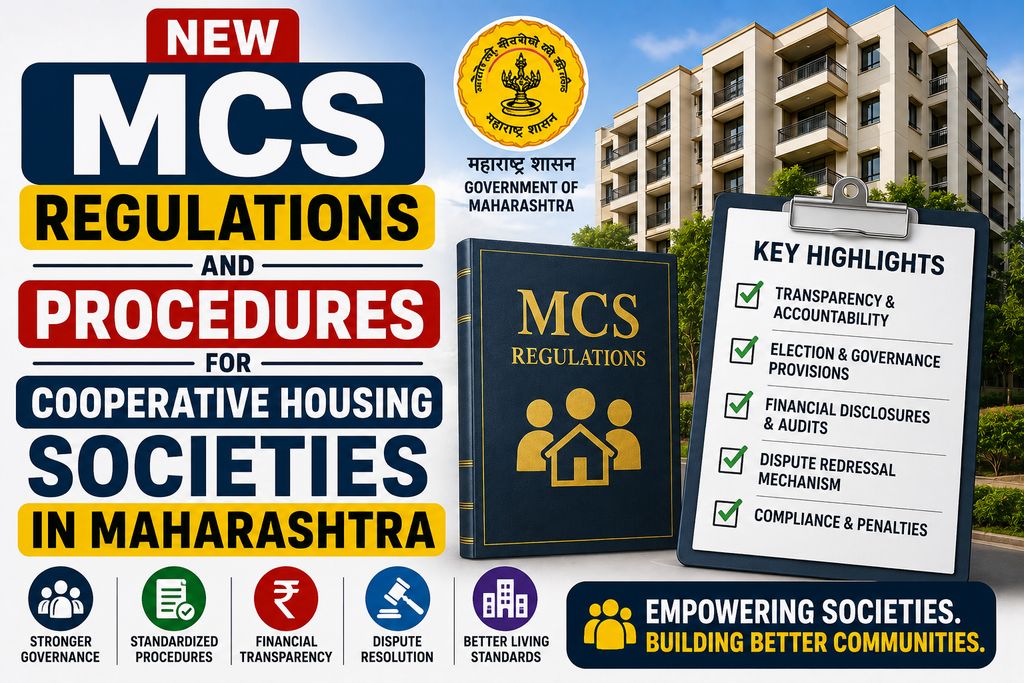
In Maharashtra, cooperative housing societies operate under a comprehensive legal framework established by the Maharashtra Co-operative Societies Act and related rules. These regulations ensure transparency, accountability, and effective governance of societies, guiding their financial management, administrative procedures, and dispute resolution mechanisms.
Financial Management and Security Deposits
Minimum Security Deposit
Housing societies and related institutions are required to maintain a security deposit or funds based on their size and activities. The amount varies according to the number of members and the scope of meetings conducted annually:
- Societies with up to 25 members must keep a security of Rupees 1,00,000.
- Those with 26-50 members should maintain Rupees 2,00,000.
- Societies with 51-100 members need to keep Rupees 3,00,000.
- For 101-1000 members, the amount increases to Rupees 4,00,000.
- Societies with more than 1000 members must retain Rupees 5,00,000.
Repair and Maintenance Funds
Societies are also mandated to create specific funds for upkeep and repairs:
- Sinking Fund: Collected at 0.25% of the construction cost annually, used for heavy repairs.
- Repair and Maintenance Fund: Collected at 0.75% annually, used for routine repairs.
- Major Repair Fund: Contributed based on area basis, used for significant refurbishments.
- Education and Training Fund: Voluntary contributions for training purposes.
- Welfare Fund: For social and cultural activities, collected voluntarily.
- Other Funds: Societies can establish additional funds with approval from the general body.
Fee Collection and Charges
Types of Charges
Societies are authorized to levy various charges from members:
- Service Charges
- Property Tax
- Water Charges
- Lift Maintenance Expenses
- Car Parking Charges
- Interest on Defaulted Payments
- Loan Repayments
- Non-Occupancy Charges
- Insurance Charges
- Lease Rent
- Taxes and Contributions to Funds
Method of Apportionment
Charges are shared among members based on specific criteria:
- Equal Division: Service charges, parking fees, welfare fund contributions.
- Carpet Area Basis: Property tax, insurance, lease rent.
- Area-Based: Major repair funds.
- Other Methods: Based on usage or decision by the general body.
Management and Governance
Adoption of Bye-laws
- Society management is governed by model bye-laws issued by the Registrar of Cooperative Societies.
- Societies must adopt these within three months of their publication.
Managing Committee
- Responsible for executing decisions, maintaining finances, approving projects, and supervising repairs.
- The committee appoints professionals like architects and contractors as needed.
- Their duties include ensuring compliance with bye-laws and regulations.
General Body
- The highest decision-making authority.
- Conducts annual meetings (AGMs) and special meetings as required.
- Quorum: Usually two-thirds of members or 20 members, whichever is less.
- Decisions are usually made by majority vote (51%).
Management of Vacancies and Repairs
Vacancy Filling
- Casual vacancies due to resignation or death are filled by the Managing Committee.
- Nominations are invited seven days before vacancy filling.
- The term of co-opted members coincides with the existing committee.
Repair Budget
- Committee can incur expenditures on repairs and maintenance based on the size of the society:
- Up to Rupees 1,00,000 for societies with up to 25 members.
- Up to Rupees 5,00,000 for societies with more than 1000 members.
Legal Recovery of Dues
Recovery Certificate
- Societies can apply for a recovery certificate under Section 154B-29.
- The application must include:
- Certificate form (“Y-6”) with court fee.
- Details of dues, resolution documents, and account summaries.
- Proof of notice served to the defaulting member.
Proceedings for Recovery
- The Registrar reviews the application for completeness.
- Upon approval, a notice is issued to the defaulting member.
- If dues remain unpaid, the society can execute recovery through officers delegated under Section 156.
- The order can be executed as land revenue arrears.
Order Implementation
- The recovery order details:
- Claim amount, including interest and other expenses.
- Expenses incurred during the recovery process.
- The amount can be recovered by the authorities without a separate court proceeding.
Conclusion
Effective governance and transparent financial management are vital for the smooth functioning of cooperative housing societies in Maharashtra. The legal framework provides strict guidelines on fund management, fee collection, governance procedures, and recovery of dues, ensuring accountability, fairness, and social harmony within society.
Download MCS Rules Marathi & English 22-06-2026