Purchasing a flat is one of the most important financial decisions for any homebuyer. However, in some cases buyers face complications when the seller is represented through a Power of Attorney holder or when the share certificate is not issued by the housing society. Many buyers worry about the legality of such transactions and the steps required to secure their ownership rights.
Understanding the legal framework under Real Estate (Regulation and Development) Act, 2016 and the provisions of the Maharashtra Cooperative Societies Act, 1960 can help protect the interests of flat purchasers.
Understanding the Role of Power of Attorney in Property Transactions
In some real estate projects, the builder may not be the direct owner of the flat at the time of sale. Sometimes the financier or investor registers the flat in their name as security against funds given to the developer. Later, the builder sells the flat through a Power of Attorney (POA) holder authorised by that person.
In such cases, the agreement may be executed by the Power of Attorney holder on behalf of the original owner. Even if the buyer has not met the actual owner, the transaction can still be valid if the Power of Attorney is legally registered and authorised.
Therefore, the buyer should always verify the Power of Attorney document, title documents and the agreement terms before signing the registration documents.
Protection of Buyers Under RERA
Homebuyers are protected under the Real Estate (Regulation and Development) Act, 2016 (RERA). The law defines an “allottee” as a person to whom a plot, apartment or building has been allotted or sold by the promoter. Importantly, this definition also includes subsequent purchasers or acquirers of the property.
This means that even if the flat was originally booked in someone else’s name and later transferred to you, you are still considered an allottee under RERA and your ownership rights remain protected.
Importance of Share Certificate in a Housing Society
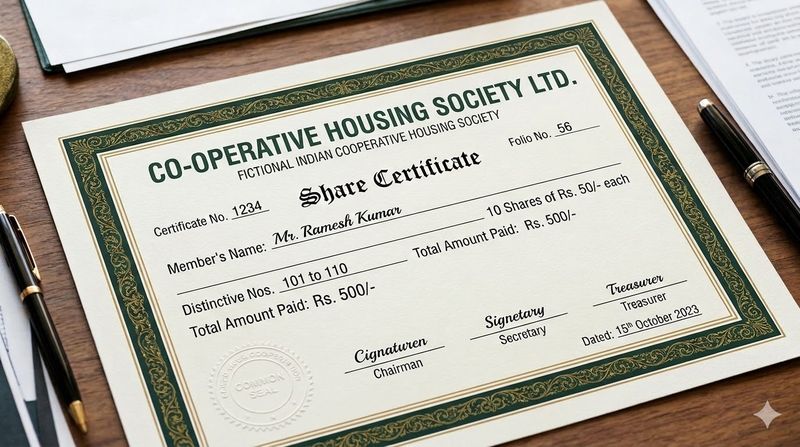
A share certificate is one of the most important documents issued by a cooperative housing society. It establishes the membership of the flat owner in the society and represents the owner’s share in the society’s property and assets.
According to Model Bye-Law 9, the society must issue the share certificate within six months of allotment to the member.
However, in newly formed societies, situations may arise where the original member has not yet received the share certificate before transferring the flat to another buyer.
Transfer of Shares When the Original Share Certificate Is Not Issued
If the flat was sold before the society issued the share certificate to the original owner, the buyer must complete the transfer formalities as prescribed under Model Bye-Law 38.
The buyer needs to submit the following documents to the society:
-
Application for transfer of shares and membership
-
Indemnity bond
-
Share transfer fee
-
Admission fee
-
Copy of the registered agreement for sale
-
Other documents required by the society
Once these formalities are completed and approved by the managing committee, the society must issue the share certificate in the name of the transferee.
Ensuring Proper Endorsement on the Share Certificate
When the society issues the share certificate, it is important to ensure that your name is endorsed as the transferee member. This endorsement confirms that the ownership rights, shares and interest in the flat have been legally transferred to you.
The share certificate serves as proof of membership and is required for several purposes such as:
-
Resale of the flat
-
Availing loans from banks
-
Participation in society meetings
-
Redevelopment or conveyance matters
What to Do If the Society Delays Issuing the Share Certificate
If the society fails to issue the share certificate within three months from the date of application, the buyer has the right to approach the Registrar of Cooperative Societies.
The registrar has the authority to direct the society to issue the share certificate and ensure compliance with the cooperative housing society laws.
Conclusion
Buying a flat through a Power of Attorney holder may appear confusing, but such transactions can be valid if the legal documents are properly executed. Buyers remain protected under RERA as allottees, even if they are subsequent purchasers of the property. If the society has not issued the share certificate to the original owner before the sale, the buyer must complete the transfer formalities under Model Bye-Law 38. After submitting the required documents and fees, the society must issue the share certificate in the buyer’s name. In case of delay, the matter can be taken up with the Registrar of Cooperative Societies to protect the buyer’s ownership rights.