
Maharashtra Draft Model Bye-Laws 2026: Key Changes for Housing Societies
The Maharashtra government has released the Draft Model Bye-Laws 2026 for Cooperative Housing Societies, proposing a major overhaul of the rules governing the everyday functioning of housing societies across the state.
The draft covers several areas that frequently lead to disputes between members and managing committees, including membership and succession, parking, maintenance charges, EV charging, digital communication, structural safety, redevelopment, pets, society funds and grievance redressal.
Importantly, these are draft proposals and have not yet replaced the existing Model Bye-Laws. Citizens and stakeholders have been invited to submit suggestions and objections before 27 August 2026.
Why Maharashtra Is Introducing New Model Bye-Laws
The proposed Model Bye-Laws are part of a wider restructuring of Maharashtra’s cooperative housing framework.
Over the past few years, amendments to the Maharashtra Cooperative Societies Act, 1960 introduced a separate framework dealing specifically with housing societies. This was followed by the Maharashtra Co-operative Societies (Amendment) Rules, 2026, which laid down detailed provisions relating to membership, succession, society funds, maintenance charges, recovery of dues and redevelopment.
The proposed Model Bye-Laws 2026 are intended to align the day-to-day operational rules of cooperative housing societies with this amended legal framework.
The existing Model Bye-Laws were last substantially revised in 2014. The 2026 draft seeks to address legal developments, technological changes and practical problems that have emerged over the last decade.
Membership, Nomination and Succession: Nominee Will Not Automatically Become Owner
One of the most important clarifications in the draft concerns what happens after the death of a member.
The proposed bye-laws incorporate the concept of a provisional member.
Where a deceased member has made a nomination, the nominee may apply for provisional membership after submitting the prescribed application and indemnity bond. Where there are multiple nominees, they may jointly authorise one person to act as the provisional member.
However, the draft makes an important distinction:
Provisional membership does not give ownership, title or beneficial interest in the flat.
The arrangement is intended only to allow someone to represent the deceased member’s interest until the person legally entitled to the property is determined.
Where no nomination exists, the society will be required to invite claims and objections from legal heirs by displaying a notice and publishing notices in two local newspapers. The draft also recognises succession certificates, legal heirship certificates, probate, letters of administration and court orders as documents relevant to the transfer of membership.
Importantly, the society itself will not be expected to decide disputes relating to the validity or interpretation of succession documents. Such disputes will have to be decided by the competent court.
Parking: One Parking Space for Each Flat Before Additional Allotments
Parking, one of the biggest causes of disputes in cooperative housing societies, receives detailed treatment in the draft.
The proposed bye-laws state that open and stilt parking spaces forming part of the approved layout or common areas cannot ordinarily be independently sold or permanently transferred.
A builder’s allotment letter, receipt or even long-term occupation of a particular parking space will not automatically create ownership or permanent proprietary rights over that space.
The draft proposes an important principle:
Subject to availability, the society must first allot one parking space to each flat or unit before considering applications for additional parking.
Only after the requirement of providing the first parking space has been addressed can the society consider additional parking allotments.
Where the number of applicants exceeds the available spaces, the society may adopt a transparent system such as:
- Waiting lists
- Draw of lots
- Rotation system
Additional parking may be allotted temporarily or annually, with proper records of allotments, cancellations, vehicle registrations and waiting lists.
Major Relief for EV Owners: Private Charging Facilities Recognised
The draft specifically addresses the growing issue of electric vehicle charging in housing societies.
Under the proposed framework, a member may install a private EV charging facility at a lawfully allotted or available parking space without requiring approval from the General Body Meeting, subject to compliance with applicable electrical, fire safety and technical requirements.
The member will have to bear the expenses relating to:
- Load augmentation
- Metering
- Cabling
- Charging equipment
- Installation
- Civil work
- Electricity consumption
- Maintenance
The society is expected to issue the required NOC or permission unless there is a legally valid, safety-related or technical reason for refusing it.
Societies may also establish common EV charging facilities for members and visitors.
Digital Notices, Emails and Online Meetings
The proposed bye-laws recognise the increasing use of technology in the management of cooperative housing societies.
A society may maintain an official email address and an approved digital communication platform. Notices, bills, communications and records may be issued or maintained electronically, subject to the applicable Act and Rules.
The framework also accommodates:
- Electronic communication
- Digital records
- Electronic copies of documents
- Audio-video participation in meetings
These provisions would help societies move towards a more organised and digitally accessible system of administration.
Repairs and Leakages: Society May Recover Cost from Defaulting Members
The draft attempts to clarify responsibility for repairs between individual members and the society.
Where a repair is the responsibility of an individual member, and failure to carry out that repair results in continuing damage to another flat or common property, the society may:
- Issue notice to the member;
- Carry out the necessary repair work; and
- Recover the actual cost from the concerned member.
Members will also be required to provide reasonable access to the society, contractors or technical experts for inspection, structural audits and repairs of common services.
In an emergency involving danger to life or property, fire, flooding, leakage, structural damage or failure of essential services, the society may enter a flat without prior notice, but only to the extent reasonably necessary to deal with the emergency.
Structural Safety: Regular Audits Continue
The draft consolidates the existing structural safety requirements.
Buildings between 15 and 30 years old are required to undergo a structural audit once every five years, while buildings older than 30 years must undergo an audit once every three years.
The audit report must be placed before the General Body Meeting, and necessary repairs and safety measures must be undertaken.
The draft also brings together provisions relating to:
- Structural audits
- Fire safety
- Lift inspections
- Maintenance of safety records
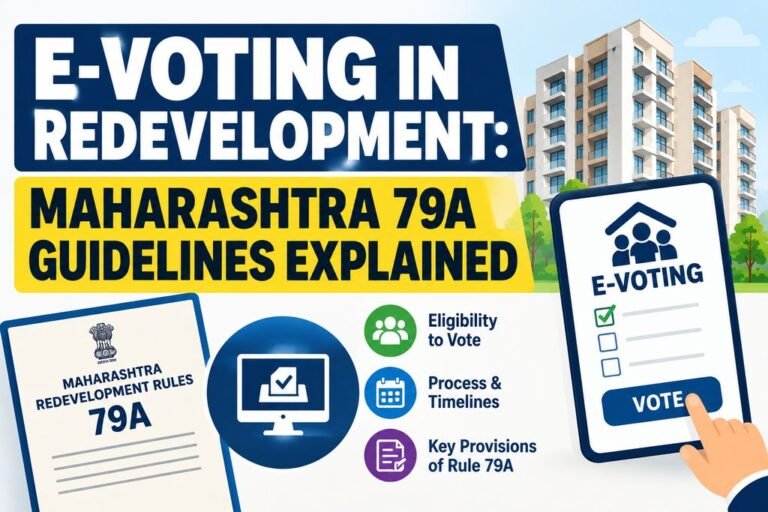
Redevelopment Gets a Detailed Framework
Redevelopment occupies a major portion of the proposed Model Bye-Laws 2026.
The draft covers:
- Developer-led redevelopment
- Self-redevelopment
- Other legally permissible redevelopment models
The General Body will play a central role in the redevelopment process.
Before proceeding, the society is expected to consider factors such as:
- Structural condition and remaining life of the building
- Feasibility and cost of major repairs
- Redevelopment potential
- Financial implications and risks
- Comparison between conventional redevelopment and self-redevelopment
The draft also emphasises a transparent process for appointing architects and project management consultants.
Due diligence before redevelopment is expected to include examination of:
- Title of the property
- Conveyance or deemed conveyance
- Sanctioned plans
- Occupancy and completion certificates
- Pending litigation
- Encumbrances
For self-redevelopment, the draft envisages separate project-related accounts, records and financial controls.
New Financial Framework for Maintenance Charges and Society Funds
The draft incorporates provisions relating to statutory and other society funds, including:
- Reserve Fund
- Sinking Fund
- Repairs and Maintenance Fund
- Major Repairs Fund, where applicable
The recently introduced Rules prescribe minimum annual contributions of:
- 0.25% of the architect-certified construction cost of each flat towards the Sinking Fund
- 0.75% towards the Repairs and Maintenance Fund
The Rules also provide that interest on overdue society dues cannot exceed 12% simple interest per annum, unless the General Body decides on a lower rate.
Similarly, non-occupancy charges are capped at 10% of service charges, excluding municipal taxes.
The draft also lays down the basis for apportioning different categories of charges, including service charges, water charges, insurance, parking and contributions to various funds.
Societies Cannot Simply Ban Pets
The proposed bye-laws also deal with everyday community living issues.
A society cannot prohibit a member from keeping a pet merely because other residents object.
However, pet owners will remain responsible for ensuring cleanliness and preventing nuisance, danger or inconvenience to other residents.
The draft also includes provisions relating to:
- Waste segregation and disposal
- Water conservation
- Rainwater harvesting
- Treated water reuse
- Composting
- Solar energy
- Renewable energy systems
- Energy-efficient lighting
Internal Grievance Redressal Committee Proposed
For societies with more than 50 members, the draft proposes the creation of an internal Grievance Redressal Committee.
The committee may comprise:
- One member of the Managing Committee; and
- Two society members who are not members of the Managing Committee.
The objective is to provide an internal mechanism for hearing complaints and attempting an amicable resolution.
However, this mechanism will not replace statutory legal remedies available to members.
The draft identifies several issues that may be taken to the Registrar or another competent authority, including:
- Refusal or delay in granting membership
- Failure to register nominations
- Excessive non-occupancy charges
- Excessive transfer charges
- Failure to provide society records
- Audit-related issues
- Failure to conduct statutory meetings or elections
Certain disputes relating to repairs, leakages, parking, General Body resolutions and appointment of developers or contractors may fall within the jurisdiction of the Co-operative Court.
Not Every Provision Is Completely New
An important point for housing society members is that the Draft Model Bye-Laws 2026 should not be viewed as an entirely new set of laws.
Several provisions already existed through earlier Model Bye-Laws, government circulars or administrative directions. Others have recently received statutory backing through amendments to the MCS Act and the housing-specific Rules notified in June 2026.
The new draft primarily seeks to bring these developments together into a more comprehensive operational framework for cooperative housing societies.
Draft Is Still Open for Suggestions and Objections
The Draft Model Bye-Laws 2026 are not yet final.
The Maharashtra Cooperation Department has invited suggestions and objections from citizens, housing societies and other stakeholders.
The deadline for submitting comments is 27 August 2026, up to 5 pm. Suggestions and objections can be submitted to the email address specified by the department: coophsgmodelbyelaws@gmail.com.
Why the Draft Model Bye-Laws 2026 Matter
If finalised, the new Model Bye-Laws could become one of the most important practical documents governing the daily functioning of cooperative housing societies in Maharashtra.
The proposals seek to address many of the disputes that repeatedly arise between members and managing committees, particularly concerning parking rights, succession, EV chargers, leakages, redevelopment, maintenance charges, pets, digital communication and handover of responsibilities.
However, members should remember that the document is presently only a draft. The final version may undergo changes after the public consultation process.
For housing societies, managing committee members and individual flat owners, this is therefore an important opportunity to study the proposed framework and submit suggestions before it becomes final.