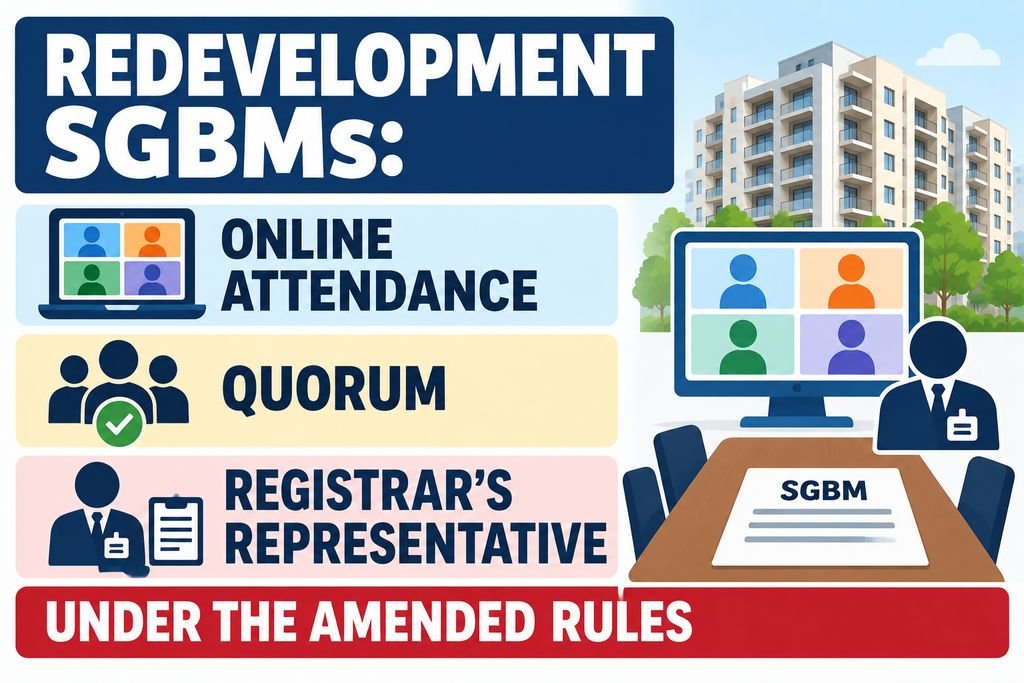
The procedure for redevelopment of cooperative housing societies has undergone an important change following the amendment to the Maharashtra Cooperative Societies Rules, 1961, notified on June 18. The amended provisions specifically deal with Special General Body Meetings (SGBMs) convened in connection with redevelopment and provide for participation through video conferencing.
The amendment is particularly significant for large housing societies where a substantial number of members live outside Mumbai, outside Maharashtra or even outside India. Obtaining the physical presence of two-thirds of the total membership has often proved difficult in such societies.
The amended provisions contained in Rule 106C-13(3)(i) and (j) therefore require careful consideration by societies proposing to undertake redevelopment.
Online Attendance Through Video Conferencing Is Now Permitted
One of the significant changes is the recognition of video-conferencing participation in a redevelopment-related SGBM.
Rule 106C-13(3)(j) provides that the resolution selecting the developer or contractor for redevelopment must be approved by 51% of the total members of the society, including members participating through video conferencing.
This is particularly relevant for societies having members who are:
- Living outside Mumbai;
- Residing in another city or state;
- Working abroad;
- Temporarily away from the city;
- Unable to attend physically for genuine reasons.
The provision therefore provides a statutory basis for members to participate in the developer-selection process through video conferencing.
Two Different Numerical Requirements Must Be Distinguished
Members should distinguish between the quorum required to commence the meeting and the number of votes required to approve the developer-selection resolution.
These are two separate requirements.
Under Rule 106C-13(3)(i), the quorum for a redevelopment-related SGBM is two-thirds of the total membership.
Therefore, if a society has 120 members, the quorum would be:
120 × 2/3 = 80 members
The SGBM would therefore require the prescribed quorum of 80 members to commence proceedings.
The position regarding the developer-selection resolution is different.
Rule 106C-13(3)(j) provides that the resolution selecting the developer or contractor must be approved by 51% of the total membership of the society, including members attending through video conferencing.
For a society having 120 members:
120 × 51% = 61.2
Therefore, the required number would effectively be 62 members, subject to the manner in which the statutory requirement is applied.
The important point is that the 51% requirement is calculated with reference to the total membership, and not merely those physically present at the meeting.
Online Participation Does Not Eliminate the Quorum Requirement
The permission to participate through video conferencing should not be confused with a reduction in the meeting quorum.
The amended Rule 106C-13(3)(i) continues to prescribe a quorum of two-thirds of the total members for a redevelopment-related SGBM.
Thus, video conferencing provides an additional mode of participation, but the prescribed quorum for commencement of the meeting remains relevant.
For example, if a society has 120 members and 50 members are physically present while another 30 participate through video conferencing, the total participation would be 80 members.
The society would therefore have reached the two-thirds quorum requirement.
This is one of the major practical benefits of the amendment.
Presence of Registrar’s Representative
Another important requirement contained in Rule 106C-13(3)(i) concerns the presence of the Registrar’s representative.
The provision states that the redevelopment-related meeting shall be conducted in the presence of the Registrar’s representative.
Accordingly, societies should not assume that the amended Rules have eliminated the requirement for the Registrar’s representative to attend the relevant redevelopment SGBM.
The representative’s role is also connected with the requirement of recording the proceedings.
Video Recording of the Meeting Is Mandatory
The amended provision also requires video recording of the meeting.
The recording is required to remain in the custody of the chairman, with one copy being kept in the office of the Assistant Registrar or Deputy Registrar having jurisdiction over the society.
This requirement is important because redevelopment resolutions can subsequently become the subject of disputes before cooperative authorities or courts.
A proper video record can provide evidence regarding:
- Attendance;
- Participation through video conferencing;
- Discussions;
- Voting;
- Resolutions passed;
- Conduct of the meeting; and
- Compliance with the prescribed procedure.
Societies should therefore ensure that the recording is properly preserved and that there is a reliable record of both physical and online participation.
Is a Registrar’s NOC Required for Selection of the Developer?
The amended provision does not appear to require a separate No Objection Certificate (NOC) from the Registrar for selection or appointment of the developer.
Rule 106C-13(3)(j) provides for the Registrar’s representative to submit a factual report regarding the conduct of the meeting to the Registrar.
The Registrar is then required to communicate the report to the society.
The provision therefore contemplates a reporting mechanism rather than an approval or NOC mechanism.
Accordingly, a society should distinguish between:
Presence of the Registrar’s representative — expressly contemplated by the amended provision.
Factual report by the representative — expressly contemplated.
Separate NOC from the Registrar for selection of the developer — not stipulated in the amended provision.
This distinction is important because the requirement of an NOC should not be introduced unless there is a specific legal or regulatory provision requiring it.
What Happens if Two-Thirds Quorum Is Not Present?
This is one of the most important unresolved issues arising from the amended provisions.
Rule 106C-13(3)(i) specifically prescribes two-thirds of the total membership as the quorum for a redevelopment-related SGBM.
However, the general provisions concerning adjourned meetings create a potential difficulty.
Under the relevant adjournment provision, where the required quorum is not present at the appointed time, the meeting may, subject to the applicable conditions, be adjourned to a later time on the same day or to a subsequent date within the prescribed period.
At the adjourned meeting, business may generally be transacted irrespective of whether the original quorum is present.
This creates an apparent tension when applied to a redevelopment SGBM.
On the one hand, Rule 106C-13(3)(i) specifically prescribes two-thirds quorum for a redevelopment meeting.
On the other hand, the general adjournment provision contemplates conducting business at an adjourned meeting even without the original quorum.
The Developer-Selection Requirement Creates a Further Difficulty
The problem becomes more complicated because Rule 106C-13(3)(j) separately requires the developer-selection resolution to receive the approval of 51% of the total membership.
Thus, there are potentially three distinct concepts:
- Two-thirds quorum for commencing the redevelopment SGBM;
- 51% of total membership for approving the developer-selection resolution; and
- The general rule concerning business at an adjourned meeting where quorum is absent.
The amended Rules do not appear to expressly explain how these provisions are to operate together in the specific context of an adjourned redevelopment SGBM.
This ambiguity could result in disputes if a society proceeds with developer selection at an adjourned meeting without the original two-thirds quorum.
Societies Should Exercise Caution With Adjourned Meetings
Until there is a clear clarification from the competent authority or an authoritative judicial interpretation, societies should adopt a cautious approach.
If the required two-thirds quorum is absent at the commencement of the redevelopment SGBM, the society should follow the prescribed adjournment procedure and maintain a complete record of attendance and proceedings.
It would also be prudent to obtain specific legal advice before proceeding to pass a developer-selection resolution at an adjourned meeting where the two-thirds quorum is not present.
This is particularly important because the developer-selection resolution requires approval by 51% of the total membership, and a challenge to the validity of the meeting could delay the entire redevelopment project.
Does the Registrar’s Representative Have to Attend Every Redevelopment SGBM?
The wording of Rule 106C-13(3)(i) also raises another question.
The provision refers to a redevelopment-related SGBM being conducted in the presence of the Registrar’s representative. However, redevelopment involves several stages, including:
- Appointment of a Project Management Consultant;
- Approval of redevelopment terms;
- Selection of a developer;
- Approval of the Development Agreement;
- Approval of other redevelopment-related documents and decisions.
The wording could potentially be interpreted broadly to cover redevelopment-related SGBMs generally.
However, whether the requirement was intended to apply to every redevelopment-related SGBM or specifically to the meeting dealing with the selection of the developer is an issue that would benefit from a clear governmental clarification.
A clarification would help avoid procedural disputes at later stages of redevelopment.
The Amendment Is Significant for Large Housing Societies
The permission for video-conferencing participation is particularly significant for large housing societies.
Consider a society with 300 members, of whom a significant number reside outside Mumbai or overseas.
Previously, physical attendance could make it extremely difficult to achieve the required quorum.
With online participation expressly recognised, members can participate without physically travelling to Mumbai.
This can make the redevelopment process more practical while also allowing members who are geographically distant to participate in an important decision concerning their property.
However, societies should establish a reliable system for verifying the identity of online participants and maintaining a proper attendance and voting record.
Proper Documentation Is Essential
A society conducting a redevelopment SGBM should maintain comprehensive records, including:
- Copy of the meeting notice;
- Proof of service of notice;
- Agenda;
- Physical attendance register;
- Online attendance record;
- Details of members participating through video conferencing;
- Video recording of the meeting;
- Minutes;
- Voting record;
- Developer-selection resolution;
- Registrar representative’s factual report; and
- All documents placed before the members.
These records can become extremely important if a member subsequently challenges the redevelopment process.
The amendment to the Maharashtra Cooperative Societies Rules, 1961, notified on June 18, introduces an important change by expressly permitting members to participate in redevelopment SGBMs through video conferencing.
However, the amendment does not appear to eliminate the two-thirds quorum requirement for commencing a redevelopment-related SGBM. At the same time, the developer-selection resolution requires approval by 51% of the total membership, including members participating through video conferencing.
The amended provisions also contemplate the presence of the Registrar’s representative and mandatory video recording of the meeting.
Importantly, the provision requiring the Registrar’s representative to submit a factual report does not itself stipulate a separate Registrar’s NOC for selection or appointment of the developer.
The major area requiring clarification is the position where the two-thirds quorum is not available and the meeting is adjourned. The interaction between the redevelopment-specific quorum provision and the general rule concerning adjourned meetings could lead to disputes.
A clear government clarification on adjourned redevelopment SGBMs, as well as the precise scope of the Registrar representative’s presence, would help housing societies avoid litigation and procedural uncertainty.
For societies undertaking redevelopment, the safest approach is to strictly document the entire process, ensure compliance with the specific redevelopment provisions and obtain appropriate legal advice wherever the amended Rules leave room for interpretation.