In cooperative housing societies, disputes often arise after the transfer of a flat through a gift deed, especially when the transferee dies soon afterward and family members raise objections. A common question before societies is whether they should reverse the transfer or await the court’s decision.
A recent situation involving a father gifting his flat to his youngest son, followed by the son’s death within a month, highlights important legal principles under the Maharashtra Cooperative Societies (MCS) Act and property laws.
Facts of the Case
A society member executed a registered gift deed transferring his flat to his youngest son. After the transfer, the son unfortunately passed away within a month. The managing committee then transferred the flat in the name of the son’s wife based on her application.
Later, the father informed the society that his will allegedly contained a clause requiring the son to pay Rs25 lakh each to his brother and sister. However, this condition was not mentioned in the registered gift deed. The father has now approached the court seeking revocation of the gift deed.
The managing committee wants to know its legal stand.
Gift Deed Prevails Over Oral Conditions or Future Will
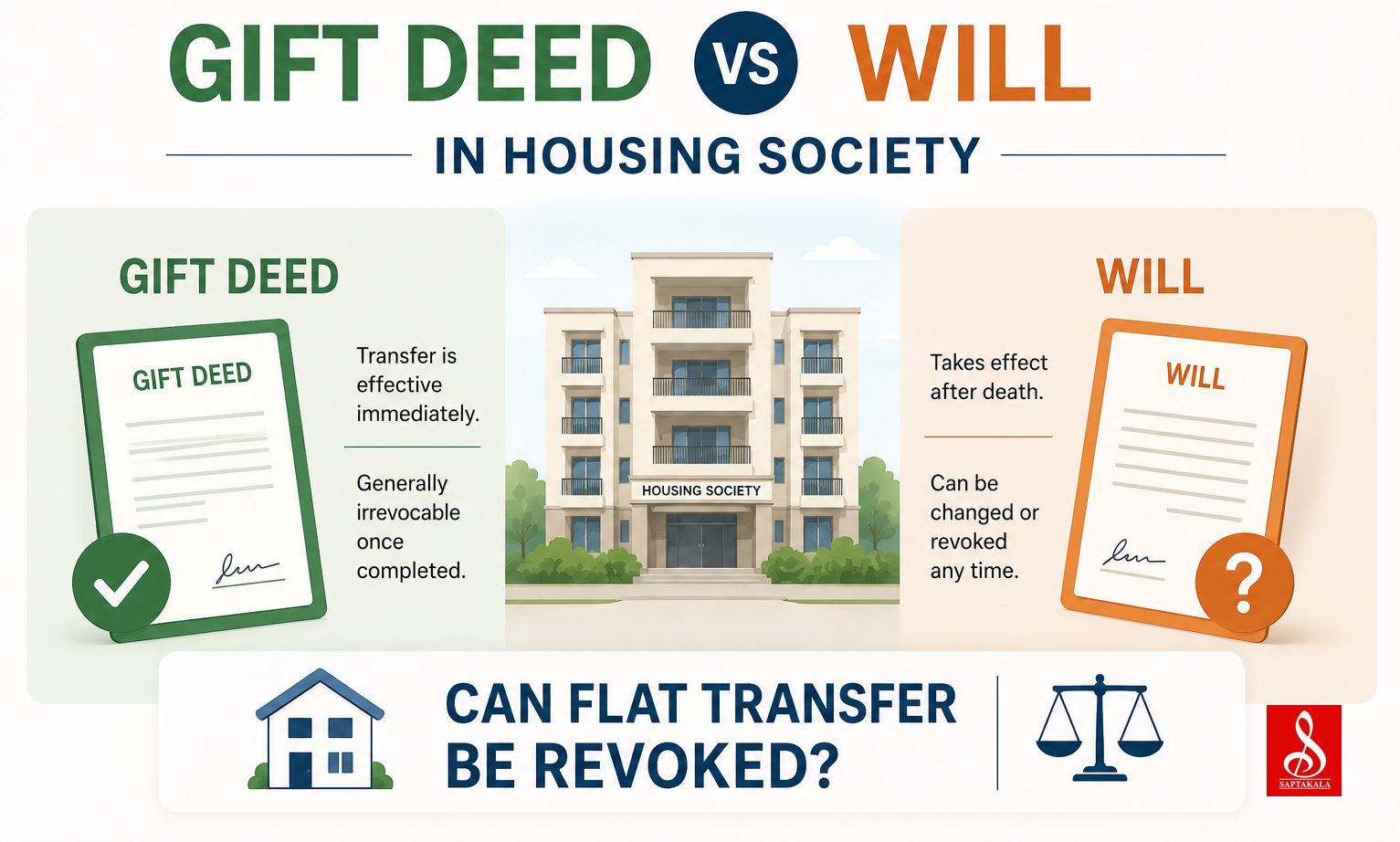
A registered gift deed is a legally valid transfer document executed voluntarily during the lifetime of the donor. Once such a document is registered and ownership is transferred, the donor loses rights over the property unless specific revocation conditions are clearly incorporated in the gift deed itself.
In this case, the alleged condition regarding payment of Rs25 lakh to siblings was not part of the registered gift deed. Therefore, the condition mentioned in the father’s will cannot override the completed transfer.
A will becomes operative only after the death of the testator. During the lifetime of the person making the will, it has no legal effect on property already transferred through a registered instrument.
Hence, the society was correct in initially transferring the flat to the son on the basis of the registered gift deed.
Whether the Society Correctly Transferred the Flat to the Son’s Wife
After the death of the son, the society transferred the flat to his wife based merely on her application. This is where the matter becomes legally sensitive.
Under Section 154B-24 of the Maharashtra Cooperative Societies Act, transfer after the death of a member should ideally be supported by proper legal documentation such as:
- Nomination
- Succession Certificate
- Probate of Will
- Letter of Administration
- Legal Heirship documents
If there was no nomination in favour of the wife and no succession-related documents were submitted, the society may have difficulty justifying the transfer if challenged in court.
The society should maintain complete records of:
- Application submitted by the widow
- Committee resolution approving the transfer
- Affidavits or indemnity bonds obtained
- Any consent letters from other legal heirs
These records may become important if litigation progresses.
Can the Father Revoke the Gift Deed?
Revocation of a registered gift deed is not easy. Under property law, a gift deed can generally be cancelled only if:
- Fraud,
- Coercion,
- Misrepresentation, or
- A clearly stated revocation clause exists in the deed.
Merely claiming that the son failed to comply with a condition not recorded in the gift deed may not be sufficient grounds for cancellation.
Therefore, the father’s legal challenge may face significant hurdles unless he proves serious legal defects in the execution of the gift deed.
What Should the Managing Committee Do Now?
The managing committee should remain neutral and avoid taking sides in the family dispute.
The society should:
- Continue maintaining records properly
- Avoid making further transfers until the dispute is resolved
- Seek legal opinion if required
- Comply strictly with any court order received
- Inform all concerned parties that the society will abide by the final judicial decision
Housing societies should remember that they are not courts of law. Their role is administrative and limited to verifying documents under the MCS Act and society bye-laws.
Important Legal Takeaways
- A registered gift deed carries legal validity immediately upon execution and registration.
- A will cannot override a completed gift transfer during the donor’s lifetime.
- Transfer after death should be based on nomination or succession documents.
- Societies must act cautiously while transferring membership after the death of a member.
- Managing committees should avoid taking unilateral decisions during pending disputes.
Conclusion
This case highlights the importance of proper documentation and legal compliance in housing society transfers. Societies should ensure that every transfer after the death of a member is supported by legally valid succession documents. While the father may pursue legal remedies, the final decision will depend on the court’s interpretation of the registered gift deed and applicable succession laws.
Until then, the managing committee should maintain neutrality and follow due process under the MCS Act and society bye-laws.