For a cooperative housing society, proper accounting of expenditure is essential to present a true and fair picture of its financial position. Every amount spent by the society cannot simply be treated as a routine maintenance expense. Depending on the nature, purpose and benefit of the expenditure, it may have to be classified as capital expenditure, revenue expenditure or deferred revenue expenditure.
Correct classification is particularly important when a society undertakes major works such as building repairs, lift replacement, structural repairs, redevelopment-related works, installation of new equipment or improvement of common facilities.
The classification also helps members understand how society funds are being utilised and enables the auditor and managing committee to maintain proper accounts.
What is Capital Expenditure?
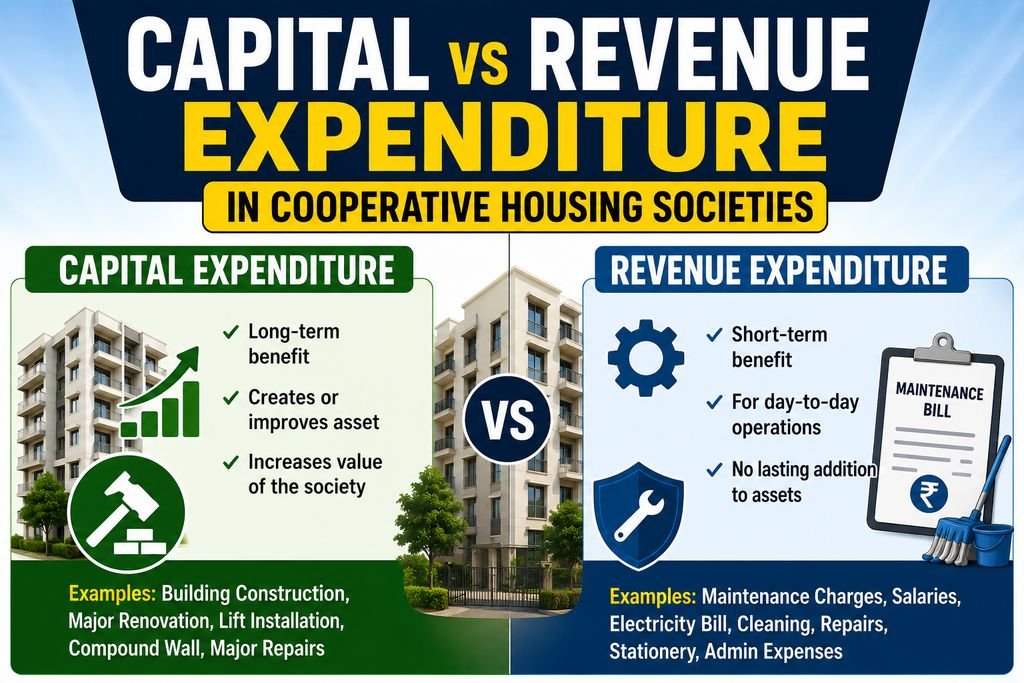
Capital expenditure generally refers to expenditure that creates or acquires an asset or provides a benefit extending beyond the current accounting period.
In simple terms, if the expenditure creates a new asset, substantially improves an existing asset, or provides a long-term benefit to the society, it may be regarded as capital expenditure.
Examples of Capital Expenditure in a Housing Society
Some common examples may include:
- Purchase of land or property
- Construction of a new permanent structure
- Installation of a new lift
- Installation of major machinery or equipment
- Construction of a new community hall or other permanent facility
- Major improvement or alteration of the society building
- Replacement of an existing asset where the replacement substantially improves its efficiency or extends its useful life
- Expenditure incurred for acquiring a permanent right or asset
For example, if a society completely replaces its 17-year-old lifts with new lifts, the expenditure may have a capital character depending upon the accounting treatment and applicable accounting standards.
Similarly, construction of a new permanent structure within the society premises is fundamentally different from routine expenditure incurred for maintaining an existing structure.
What is Revenue Expenditure?
Revenue expenditure is generally expenditure incurred in the ordinary course of managing and maintaining the society. The benefit normally relates to the current accounting period or to the ongoing maintenance of existing assets.
In a cooperative housing society, this could include:
- Routine building maintenance
- Electricity charges
- Water charges
- Security expenses
- Salaries and wages
- Cleaning expenses
- Gardening expenses
- Minor repairs
- Routine plumbing repairs
- Routine electrical repairs
- Lift maintenance contracts
- Pest-control expenses
- Administrative expenses
- Accounting and audit expenses
The important distinction is that routine repairs generally maintain an existing asset rather than create a new asset or substantially increase its capacity.
Major Repairs and Routine Repairs: An Important Distinction
One of the most common accounting questions for housing societies is whether repair expenditure should be treated as capital or revenue expenditure.
A routine repair that merely maintains the existing condition of the building would generally have a revenue character.
On the other hand, expenditure that results in a substantial improvement, replacement or extension of the useful life or efficiency of an asset may have a capital character, depending on the facts and applicable accounting principles.
Therefore, the description “repairs” alone does not determine the accounting treatment.
The managing committee should consider:
- What was the condition of the asset before the expenditure?
- What exactly was done?
- Was an existing asset merely maintained?
- Was a new asset created?
- Was the useful life substantially extended?
- Was the capacity or efficiency increased?
- Is the benefit likely to extend over several accounting periods?
The society’s auditor should make the appropriate classification based on the applicable accounting framework.
What is Deferred Revenue Expenditure?
There can also be expenditure which is revenue in nature but unusually large, with the benefit expected to extend over more than one accounting period.
Traditionally, such expenditure has sometimes been described as deferred revenue expenditure, with the cost spread over several years.
However, societies should not automatically spread every large expense over several years merely because it is expensive. The accounting treatment must follow the applicable accounting standards and the society’s prescribed accounting framework.
Therefore, the size of an expense by itself does not determine whether it is deferred revenue expenditure.
Capital Expenditure vs Revenue Expenditure
The distinction can be understood as follows:
| Capital Expenditure | Revenue Expenditure |
|---|---|
| Creates or acquires an asset | Maintains an existing asset |
| Provides long-term benefit | Primarily relates to current operations/maintenance |
| May substantially improve an asset | Normally does not substantially improve the asset |
| Examples include new equipment or permanent structures | Examples include routine repairs, cleaning and security |
| Generally affects the society’s assets | Generally affects current expenditure |
Examples Relevant to Cooperative Housing Societies
1. Routine Lift Maintenance
Annual maintenance of existing lifts is generally a revenue expenditure because it is incurred to keep the existing lifts operational.
2. Replacement of Old Lifts
Complete replacement of old lifts with new lifts is materially different from routine maintenance. Depending on the applicable accounting treatment, it may have a capital character, particularly where a new asset is effectively acquired.
3. Minor Plumbing Repairs
Replacing a damaged pipe or repairing a leaking tap would normally be treated as routine maintenance expenditure.
4. Major Structural Work
Major structural work requires careful examination. The society should not decide its accounting treatment merely by calling it a “repair fund” expenditure. The nature and effect of the work should be examined by the society’s auditor and technical professionals wherever necessary.
5. Painting of the Building
Routine periodic painting undertaken to maintain the building would ordinarily have a revenue character.
However, the accounting treatment can depend upon the nature and scale of the work and the applicable accounting requirements.
Capital Receipts and Revenue Receipts
The distinction is not limited to expenditure. A society may also receive different types of amounts, and these receipts should be properly classified.
A revenue receipt generally arises from the ordinary activities of the society or represents recurring income.
Examples may include:
- Maintenance collections
- Interest income
- Certain service-related charges
- Other recurring receipts
A capital receipt, on the other hand, may arise from a transaction involving a capital asset or another transaction of a capital nature.
For example, proceeds arising from disposal of a society-owned fixed asset may have a capital character.
The actual accounting treatment, however, depends on the nature of the transaction and the applicable accounting rules.
Why Correct Classification Matters
Incorrect classification can create several problems for a housing society.
1. Financial Statements May Become Misleading
If a major capital expenditure is incorrectly recorded as an ordinary expense, the society’s financial statements may not accurately reflect its assets and financial position.
2. Audit Objections
The society’s auditor may raise an objection if expenditure has not been appropriately classified or supported by adequate documentation.
3. Misunderstanding Among Members
Members may incorrectly believe that large amounts have been spent on routine maintenance when the expenditure actually relates to acquisition or improvement of an asset.
4. Improper Utilisation of Society Funds
Where money has been collected for a specific purpose—such as structural repairs or a sinking fund—the society must also examine whether the proposed expenditure is permissible under the applicable MCS Act, Rules and registered bye-laws.
Accounting classification and authority to spend are two different questions.
Sinking Fund and Capital Expenditure
A society may maintain a sinking fund for specified long-term purposes. The fact that an expenditure is capital in nature does not automatically mean that the sinking fund can be used for it.
The society must examine:
- The registered bye-laws
- The purpose for which the sinking fund was created
- The resolution of the general body, where required
- Applicable provisions of the Maharashtra Cooperative Societies Act and Rules
- The advice of the society’s auditor and technical professionals
For major expenditure, the society should maintain proper records showing why the work was necessary, how the expenditure was approved and how the funds were utilised.
The Role of the Managing Committee
The managing committee is responsible for administering the affairs and property of the society within the framework of the applicable law and the society’s registered bye-laws.
Before incurring substantial expenditure, the committee should ensure that there is:
Technical justification → Proper quotation/tender process → Committee approval → General body approval wherever required → Proper accounting → Supporting bills and vouchers → Audit trail
This becomes particularly important when the expenditure involves lakhs of rupees from members’ contributions.
The Role of the General Body
For major projects, the general body may have to consider and approve the proposal depending upon the nature of the expenditure and the requirements of the applicable law and bye-laws.
Members should therefore be provided with sufficient information about:
- Estimated cost
- Nature of work
- Contractor/vendor
- Technical report
- Source of funds
- Whether sinking fund or repair fund is proposed to be used
- Expected benefit
- Payment schedule
Transparency in financial decisions can substantially reduce disputes within the society.
Capital and Revenue Classification Is Not Based Merely on the Amount
An important principle is that a large expenditure is not necessarily capital expenditure, and a small expenditure is not necessarily revenue expenditure.
The nature and purpose of the expenditure are more important than merely its monetary value.
For example, replacing a small but important component may remain a maintenance expense, while acquiring a completely new asset—even if relatively inexpensive—may have a capital character.
Therefore, the society should avoid adopting a blanket rule such as:
“All expenses above a particular amount are capital expenses.”
Such a rule may not correctly reflect the nature of the transaction.
Proper Documentation Is Essential
Every significant expenditure should be supported by appropriate documentation.
The society should preserve:
Structural audit reports, architect’s recommendations, quotations, comparative statements, work orders, contracts, invoices, payment records, photographs, completion certificates and general body resolutions, wherever applicable.
These records are particularly useful during the society’s annual audit and if a dispute subsequently arises regarding utilisation of funds.
Conclusion
The distinction between capital expenditure and revenue expenditure is important for every cooperative housing society.
Routine expenses such as security, cleaning, electricity, salaries and ordinary maintenance generally relate to revenue expenditure, while acquisition of assets, construction of permanent facilities and substantial improvements may have a capital character.
However, the classification must be determined from the actual nature of the transaction, the benefit obtained and the applicable accounting requirements.
For housing societies, correct accounting should go hand in hand with proper approval, transparent utilisation of funds and compliance with the registered bye-laws. A society should therefore consult its auditor and, where necessary, its architect or other professional before classifying substantial expenditure or utilising dedicated funds such as the sinking fund.
Key Takeaway
Capital expenditure creates or substantially improves a long-term asset; revenue expenditure generally maintains the society’s existing operations and assets. The correct classification helps ensure accurate accounts, proper auditing and transparency to members.