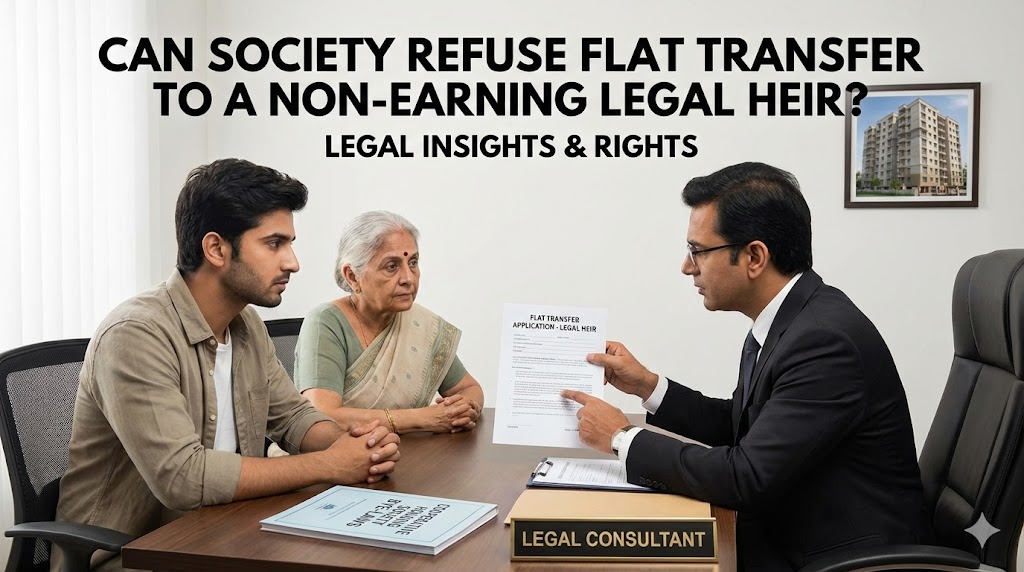
When a member of a cooperative housing society passes away, the society is required to process the transfer of shares and interest in the flat in favour of the legal heir or nominee, subject to submission of proper documentation. A common concern arises when the prospective transferee is unemployed or financially dependent on another family member.
The question is whether the society can refuse transfer due to apprehension about recovery of future dues.
The legal position is clear — earning capacity is not a qualification for membership.
Membership Is Not Linked to Employment Status
Every member of a cooperative housing society is liable to contribute towards:
-
Monthly maintenance charges
-
Sinking fund
-
Repair fund
-
Property taxes (if applicable)
-
Any other common expenses
This obligation exists irrespective of whether the member is earning or not. The law does not disqualify a person from becoming a member merely because he is unemployed.
Therefore, the society cannot refuse transfer solely on the ground that the transferee is not earning.
Liability to Pay Society Dues
Under the provisions of the Maharashtra Co-operative Societies Act, 1960, particularly Section 154B-29, a society has the right to recover its legitimate dues from a defaulting member through statutory recovery mechanisms.
This legal safeguard ensures that society dues are recoverable regardless of the financial condition of the member.
Practical Safeguard – Undertaking from Financially Responsible Relative
In cases where the prospective member is financially dependent, the society may take a practical precaution.
The managing committee may require an undertaking from the next of kin or dependent relative (for example, the married sister in this case) stating that:
-
She is willing to take responsibility for discharge of current and future society dues
-
She undertakes to pay maintenance and other charges in case of default
-
She acknowledges that the society may initiate recovery proceedings against both her and the member in case of non-payment
The undertaking should include:
-
Full name and contact details
-
Occupation and employer details
-
Residential and office addresses
-
Income particulars
This ensures transparency and financial assurance to the society.
Can the Society Delay the Transfer?
Once all legal documents are submitted — such as:
-
Death certificate
-
Nomination papers or legal heirship certificate
-
Indemnity bond (if required)
-
Application for transfer
the society is legally bound to process the transfer within the prescribed time. The financial dependency of the heir is not a valid ground to reject or indefinitely delay admission.
Recovery Rights Remain Intact
Even after transfer:
-
The society retains full rights to recover dues
-
Charges can be treated as a charge on the flat
-
Statutory recovery process can be initiated under Section 154B-29
Therefore, the society’s financial interests remain protected.
Conclusion
A non-earning legal heir cannot be denied membership merely because he is financially dependent. Every member is liable to pay maintenance charges irrespective of employment status. As a precautionary measure, the society may obtain a written undertaking from the relative who supports the member financially. With this safeguard and statutory recovery rights under the MCS Act, the society’s liabilities remain adequately secured.