
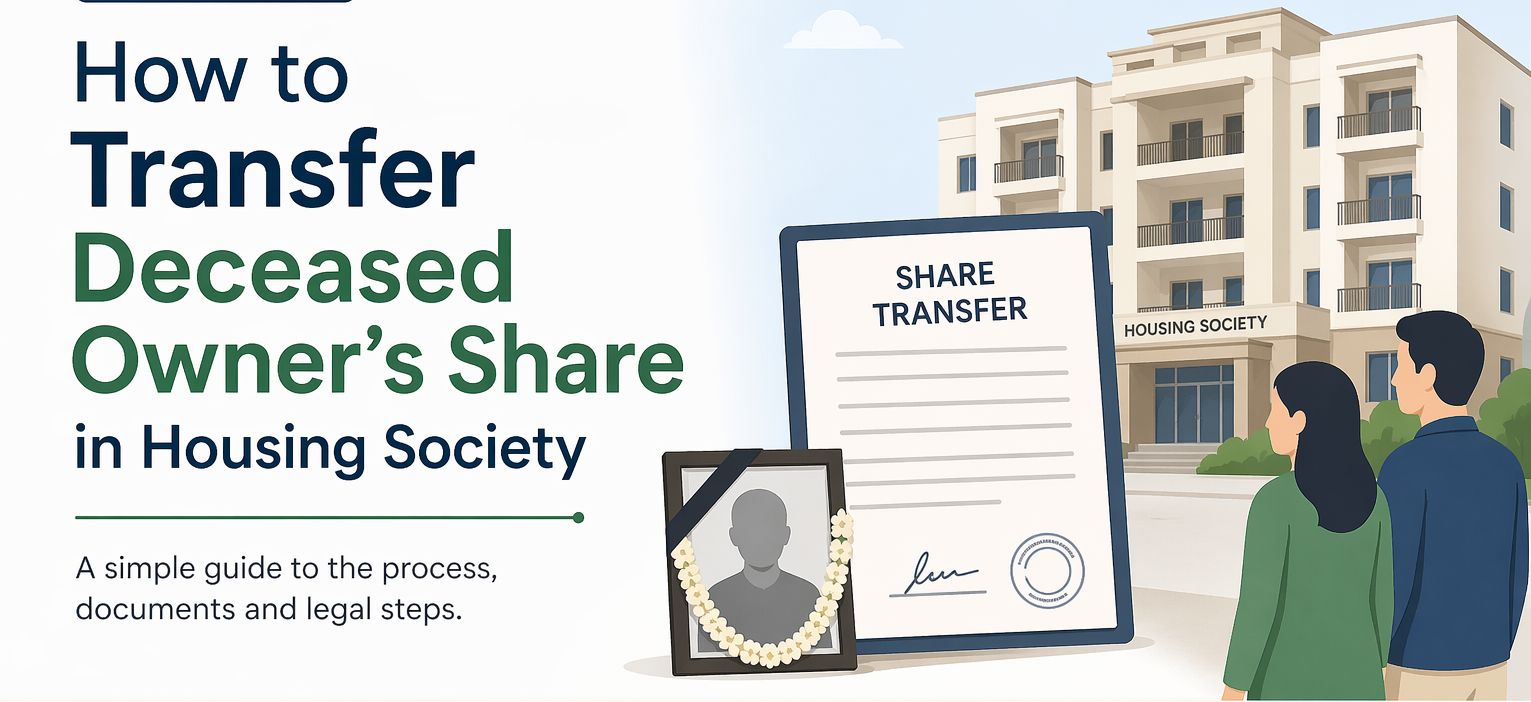
Losing a co-owner—especially a parent—creates both emotional and legal challenges. When a flat is held jointly and one holder passes away, the transfer of share, title, and interest must follow a clear legal process. Let’s understand what you need to do in your situation.
Key Issue: Is NOC on Stamp Paper Valid for Transfer?
Many people believe that a No Objection Certificate (NOC) is enough to transfer ownership. However:
- NOC is NOT a valid legal instrument for transfer of property
- Transfer must be done through a registered document
- Society cannot act on NOC alone
This is because property rights are governed by formal legal procedures under
Maharashtra Cooperative Societies Act, 1960
What Happens If There Is No Will?
In your case:
- Your mother did not leave a Will
- Hence, succession will be governed by inheritance laws
All legal heirs are entitled to a share:
- Two sons
- One surviving daughter
- Legal heirs of the deceased daughter
This means the 50% share of your mother will be distributed among all heirs, unless they relinquish their rights.
Available Legal Options for Transfer
To transfer your mother’s share entirely in your name, you have two primary options:
1. Registered Release Deed
- All legal heirs must:
- Sign a Release (Relinquishment) Deed
- Declare they give up their rights in your favour
- Must be:
- Stamped and registered
This is the most common and straightforward method.
2. Family Arrangement Agreement
- All heirs agree on distribution of property
- Document must be:
- Written, stamped, and registered
- Useful when:
- Multiple assets are involved
Procedure to Be Followed with the Society
Once you complete the legal documentation:
- Submit application to society with:
- Copy of registered deed
- Death certificate of your mother
- Share certificate copy
- Society will:
- Place the matter before the Managing Committee / General Body
- Approve transfer
- Post approval:
- Name of deceased member will be deleted
- Your name will be recorded as sole owner
- Share certificate will be endorsed/updated
These steps are governed under Sections 154B-12 and 154B-13 of
Maharashtra Cooperative Societies Act, 1960
Important Points to Remember
- Society cannot transfer shares based on:
- NOC
- Affidavit
- Informal consent
- Registered legal document is mandatory
- Legal heirs must:
- Either claim their share
- Or formally relinquish it
What If Heirs Do Not Cooperate?
If any heir refuses:
- You cannot claim full ownership directly
- You may need to:
- File a succession case in court
- Obtain a succession certificate or court order
Role of Share Certificate
After transfer:
- Society will:
- Update share certificate
- Record changes in:
- Membership register
- Property records
This ensures your ownership is legally recognised within the society.
Conclusion
An NOC—even on stamp paper—does not transfer ownership rights. In the absence of a Will, all legal heirs have a claim. To become the sole owner, you must obtain a registered release deed or family arrangement from all heirs and submit it to the society. Once done, the society is bound to update records and transfer the shares in your name.