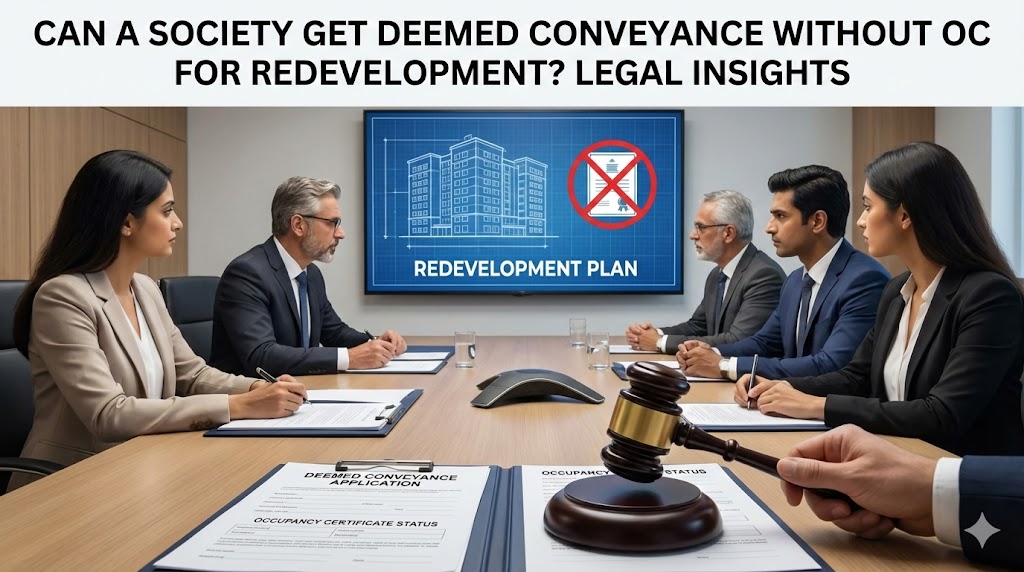
The Bombay High Court, in a significant judgment, has clarified the jurisdiction of Cooperative Courts in disputes relating to redevelopment of cooperative housing societies. The ruling draws an important distinction between jurisdiction and maintainability, especially when redevelopment activities are challenged by society members.
This decision has wide implications for housing societies in Maharashtra, particularly those undertaking or planning redevelopment projects without explicit provisions in their bye-laws.
The case arose from a dispute involving The Bank of India Staff Panchsheel Cooperative Housing Society Limited, which challenged an order passed by the Cooperative Appellate Court. The primary legal question was whether disputes relating to redevelopment resolutions fall within the jurisdiction of the Cooperative Court under the Maharashtra Cooperative Societies Act, 1960.
Parties to the Dispute
• Petitioner: The cooperative housing society
• Respondent No.1: Jitendra Kumar Jani, a member of the society
• Respondent No.2: Deputy Registrar, Cooperative Societies
• Respondent No.3: Vikas R. Korade, Authorized Officer
Respondent No.1 filed Dispute No. CC/III/49/2024 before the Cooperative Court, challenging resolutions passed in the general body meeting concerning redevelopment and seeking interim relief.
The society opposed the dispute by filing an application under Order VII Rule 11 of the Code of Civil Procedure, contending that redevelopment matters do not fall within the Cooperative Court’s jurisdiction, especially when redevelopment is not part of the society’s bye-laws.
Appellate Court’s View
The Cooperative Appellate Court rejected the society’s objection, set aside the dismissal order, and restored the dispute. It held that such disputes can fall within the Cooperative Court’s jurisdiction.
Key Legal Arguments Before the High Court
Definition of Housing Society
Under Section 154B(1)(17) of the Maharashtra Cooperative Societies Act, 1960, a housing society may include activities such as demolition and reconstruction, provided such activities are mentioned in the bye-laws.
Highlight: This definition is enabling, not mandatory. Societies may adopt redevelopment as an object but are not compelled to do so.
Impact of the 2019 Amendment
The 2019 Amendment expanded the scope of housing society activities to include redevelopment. However, Section 154B(31)(1) contains a crucial saving clause:
• Existing bye-laws continue unless formally amended
• Redevelopment does not automatically become society business
Highlight: The amendment does not override or auto-amend society bye-laws.
Jurisdiction vs Maintainability Explained
The High Court strongly emphasized the difference between:
• Jurisdiction: Legal authority of the court
• Maintainability: Whether the dispute qualifies procedurally
The court clarified that Order VII Rule 11 applies only when a dispute is clearly barred by law on the face of pleadings, not when facts need examination.
Court’s Reasoning
The High Court observed that determining whether redevelopment is part of a society’s objects requires:
• Examination of bye-laws
• Review of resolutions
• Consideration of factual evidence
These are mixed questions of law and fact, which cannot be decided at a preliminary stage.
Highlight: A dispute cannot be rejected solely on disputed facts without a full trial.
The Bombay High Court dismissed the petition filed by the society, upheld the Appellate Court’s order, and allowed the dispute to proceed before the Cooperative Court.
Broader Implications for Housing Societies
• Redevelopment is not automatic unless included in bye-laws
• General body resolutions remain central to redevelopment decisions
• Courts will allow disputes involving factual inquiry to proceed
Key Legal Takeaway
• Cooperative Court jurisdiction is determined by statute
• Bye-laws play a decisive role in redevelopment disputes
• Order VII Rule 11 cannot be used to short-circuit factual trials
Conclusion
This judgment reinforces procedural discipline in cooperative housing disputes and provides clarity on redevelopment-related litigation. It confirms that redevelopment disputes are not excluded from Cooperative Court jurisdiction by default, and that factual examination through trial remains essential where bye-laws and resolutions are in question.