
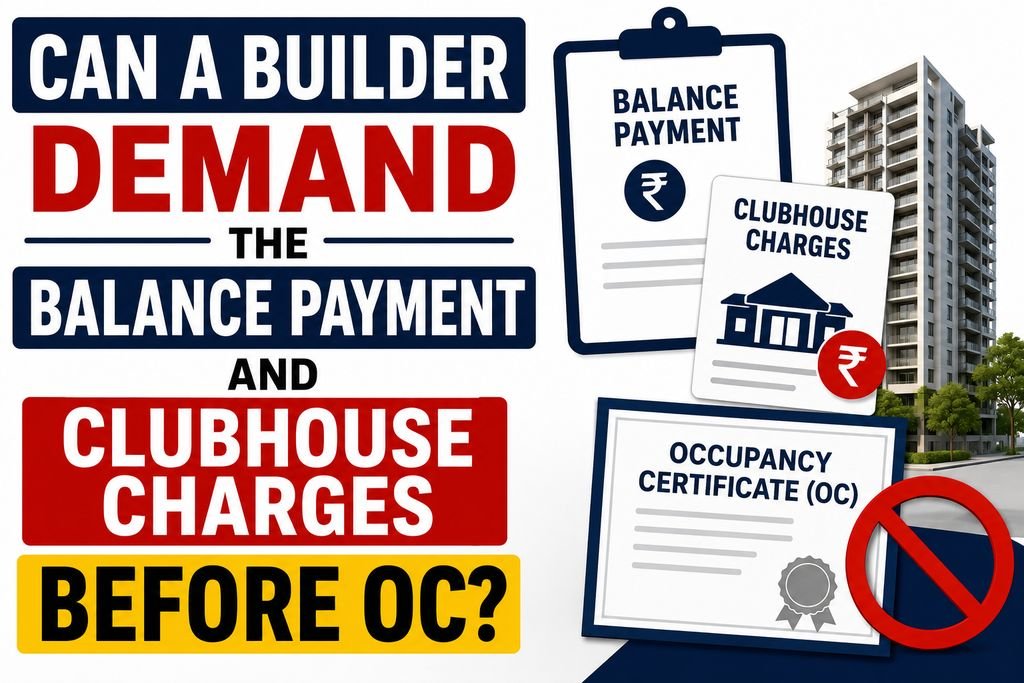
A homebuyer cannot be compelled to accept “fit-out possession” as a substitute for legal possession. Where the agreement for sale provides for possession after completion of the project and obtaining the required Occupation Certificate (OC), the purchaser should carefully examine any demand for the final instalment, clubhouse charges, advance maintenance or other additional amounts before making payment.
In the present case, the flat was booked in 2017, the registered agreement promised possession by December 31, 2021, and the purchaser has already paid ₹85 lakh out of the total consideration of ₹90 lakh. The builder is now demanding the balance ₹5 lakh, together with another ₹7 lakh towards the clubhouse, swimming pool, one year’s advance maintenance and society formation charges, while threatening cancellation if the amount is not paid.
This raises several important questions concerning fit-out possession, OC, delayed possession interest, additional charges and the builder’s right to cancel the booking.
What Is Fit-Out Possession?
A fit-out possession is generally offered to enable a purchaser to enter the premises for carrying out interior work, such as:
- Modular kitchen installation
- Electrical fittings
- False ceiling
- Wardrobes
- Painting
- Flooring or other permitted interior work
It is important to distinguish this from legal possession of the apartment.
The mere fact that a purchaser is allowed to enter a flat for interior work does not necessarily mean that the promoter has fulfilled its obligation to deliver possession under the agreement for sale.
Under Section 18 of RERA, where a promoter fails to give possession in accordance with the agreement, an allottee who continues with the project is entitled to interest for every month of delay until handing over of possession.
OC Is Crucial for Actual Possession
The Occupation Certificate is an important approval demonstrating that the building or relevant part of it can be occupied in accordance with the applicable planning and building regulations.
Therefore, a purchaser should be cautious when a promoter says:
“Take fit-out possession now and we will obtain the OC later.”
This arrangement should not automatically be treated as equivalent to contractual possession.
MahaRERA orders have recognised the significance of possession being handed over with the OC, and in appropriate cases interest for delay can continue until actual possession.
The purchaser should therefore check the exact wording of the registered agreement for sale, including the possession clause and the payment schedule.
Can the Builder Demand the Last 5% Before OC?
This is one of the most important issues in the present case.
The purchaser has paid:
Total consideration: ₹90 lakh
Amount already paid: ₹85 lakh
Balance: ₹5 lakh
The builder is demanding the balance while offering only fit-out possession, even though the OC is expected only later.
The purchaser should not automatically assume that the final instalment is payable merely because the builder has offered access to the flat for fit-outs.
The contractual payment schedule must first be examined.
If the agreement links the final instalment to possession, completion or obtaining the OC, the purchaser has a strong basis for insisting that the contractual condition be fulfilled before the final payment becomes due.
At the same time, the purchaser should avoid simply refusing payment without examining the agreement. The safest course is to make a written, legally reasoned response and record readiness to pay the legitimately payable amount upon fulfilment of the contractual conditions.
The Builder Cannot Use Cancellation as a Pressure Tactic
A particularly serious aspect of the case is the alleged threat:
“Pay the additional amount or your booking will be cancelled.”
Cancellation of an allotment is not something a promoter can ordinarily undertake arbitrarily.
The agreement for sale and RERA framework govern the respective rights and obligations of the promoter and allottee.
If the purchaser has substantially complied with the payment schedule and the dispute concerns the promoter’s premature or disputed demand, the purchaser should immediately put his or her objection in writing.
The letter should specifically state that:
The purchaser is ready and willing to comply with legitimate contractual obligations but does not accept an unsupported demand for additional amounts or premature possession.
This distinction is important.
It demonstrates that the purchaser is not refusing to pay, but is disputing amounts that are not presently contractually due.
What About the ₹7 Lakh Clubhouse and Other Charges?
The demand for an additional ₹7 lakh requires separate examination.
The purchaser should not treat all components of this demand as one consolidated amount.
The builder should be asked to provide a complete item-wise breakup, including:
- Clubhouse charges
- Swimming pool charges
- Advance maintenance
- Society formation charges
- Any other infrastructure or amenity charges
- Applicable taxes
- Contractual basis for each charge
The purchaser should then compare each demand with the registered agreement for sale and the project’s RERA disclosures.
If an amount was already included in the agreed consideration, the promoter should not simply demand it again under another heading.
Similarly, if a charge was never contractually agreed or properly disclosed, its enforceability needs to be examined separately.
RERA Protects the Allottee Against Delayed Possession
Section 18 of RERA provides an important remedy where the promoter fails to complete the project or give possession in accordance with the agreement for sale.
An allottee who wishes to remain in the project is entitled to interest for every month of delay until handing over of possession at the prescribed rate.
MahaRERA decisions have also applied this principle by directing that interest be paid for delayed possession and, in appropriate cases, adjusted against amounts payable by the allottee at possession.
Therefore, the purchaser should not look only at the builder’s demand for ₹5 lakh.
The purchaser should also calculate:
How much interest is payable by the builder for delayed possession?
What Is the Correct Date for Calculating Delay?
The starting point is ordinarily the possession date specified in the registered agreement for sale, subject to any legally applicable extension or moratorium.
Here, the contractual possession date is stated to be:
December 31, 2021
The purchaser states that the promoter received an extension up to December 31, 2024.
Whether that extension completely eliminates the promoter’s liability for the intervening period cannot be determined merely from the fact that an extension was obtained. The precise MahaRERA orders/circulars, agreement terms and applicable COVID-related relief must be examined.
The calculation should therefore be based on the legally recognised possession date after taking into account any valid extension or statutory/regulatory relief.
Interest Should Be Calculated on the Amount Paid
Where the allottee remains in the project, Section 18 provides for monthly interest during the period of delay.
The amount on which interest is calculated and the applicable rate must be determined from the actual payment history and the applicable Maharashtra RERA Rules.
Therefore, the purchaser should prepare a complete payment statement showing:
| Particular | Amount |
|---|---|
| Total consideration | ₹90 lakh |
| Amount paid | ₹85 lakh |
| Balance claimed by builder | ₹5 lakh |
| Additional amount demanded | ₹7 lakh |
| Total additional demand | ₹12 lakh |
The purchaser should then separately calculate the interest payable by the promoter.
Can the Builder Cancel the Flat Because the Purchaser Refuses Fit-Out Possession?
A purchaser should be particularly careful here.
The purchaser should not merely write:
“I refuse to pay.”
Instead, the communication should say:
“I am ready and willing to pay all amounts legally and contractually payable, subject to the promoter complying with the terms of the registered agreement for sale and obtaining the requisite OC.”
This makes the purchaser’s position much stronger.
If the promoter threatens cancellation despite the purchaser’s willingness to comply with the agreement, the purchaser can place the entire correspondence before MahaRERA.
Can the Purchaser Claim Delay Interest Even If the Builder Offers Fit-Out Possession?
Offering fit-out access does not necessarily extinguish the promoter’s obligation regarding contractual possession.
The crucial question is whether there has been valid handing over of possession in accordance with the agreement and applicable law.
MahaRERA’s appellate jurisprudence has considered claims for interest up to the date of actual possession and has recognised the significance of possession with the required OC.
Therefore, a purchaser should not sign a document stating that he or she has received “full and final possession” merely because the builder has offered fit-out access.
Should the Purchaser Take Fit-Out Possession?
There is no universal answer.
If the purchaser accepts fit-out possession, the document should clearly state that:
“Fit-out access is being accepted without prejudice to the allottee’s rights regarding delayed possession, interest, OC and other claims.”
The purchaser should also avoid signing any declaration stating that:
- Possession has been finally accepted;
- There is no delay;
- No interest is payable;
- All claims against the promoter are settled;
- The purchaser has no further grievance.
Such language can create avoidable disputes later.
What Documents Should the Purchaser Collect?
Before making any further payment, the purchaser should obtain copies of:
1. Registered Agreement for Sale
Pay particular attention to the possession clause and payment schedule.
2. RERA Project Details
Verify the project’s registered completion date, extensions and uploaded approvals.
3. Latest Project Approvals
Obtain the latest position regarding the OC and other completion permissions.
4. Complete Demand Letter
The promoter’s demand should be in writing.
5. Item-Wise ₹7 Lakh Breakup
Do not accept a consolidated demand without understanding each component.
6. Payment Statement
Obtain a complete account of all amounts paid and outstanding.
7. Correspondence Regarding Extension
Any extension obtained for the project should be examined carefully.
What Should the Purchaser Do Now?
A prudent course would be to send a formal written communication to the promoter immediately.
The communication should:
- Confirm that ₹85 lakh has already been paid.
- Dispute any amount not supported by the registered agreement.
- Request an itemised statement of the ₹7 lakh demand.
- State that fit-out access is not being treated as final legal possession.
- Request a copy of the OC immediately upon issuance.
- Record readiness to pay the amount legally due under the agreement.
- Reserve the right to claim interest for delayed possession under Section 18.
- Call upon the promoter not to cancel the allotment arbitrarily.
- Reserve the right to approach MahaRERA.
Remedy Before MahaRERA
If the builder refuses to provide the OC, insists on disputed charges, threatens cancellation or fails to address the delay-interest claim, the purchaser can consider filing a complaint before MahaRERA seeking appropriate relief.
Depending on the facts and relief sought, the complaint can raise issues concerning:
Delayed possession + Interest + OC + Additional charges + Cancellation threat + Compliance with the registered agreement
RERA’s statutory framework expressly provides a remedy for delayed possession.
Important Point About the ₹7 Lakh Demand
The ₹7 lakh demand should not automatically be assumed to be illegal, because its validity depends upon what the registered agreement for sale, RERA disclosures and applicable law provide.
However, the promoter should clearly establish:
What is being charged? Why is it being charged? Where was it agreed? When does it become payable?
A purchaser should not make a large additional payment merely because the promoter has threatened cancellation.
Conclusion
In the circumstances described, the purchaser has several important points in his favour, but the precise position depends upon the registered agreement for sale, RERA records, extension orders and the exact breakup of the builder’s ₹7 lakh demand.
The most important distinction is between fit-out access and lawful possession.
The purchaser has already paid approximately 94.44% of the ₹90 lakh consideration. The builder’s demand for the remaining ₹5 lakh, plus ₹7 lakh of additional charges, should therefore be carefully scrutinised rather than paid under pressure.
Most importantly, the purchaser should not sign away his delayed-possession or interest claims merely by accepting fit-out access.
Where possession has been delayed beyond the legally recognised date, Section 18 of RERA provides a statutory basis for claiming interest if the allottee continues with the project.
If the promoter continues to insist on disputed payments or threatens cancellation, approaching MahaRERA with the registered agreement, payment receipts, demand letters and correspondence may be an appropriate next step.