
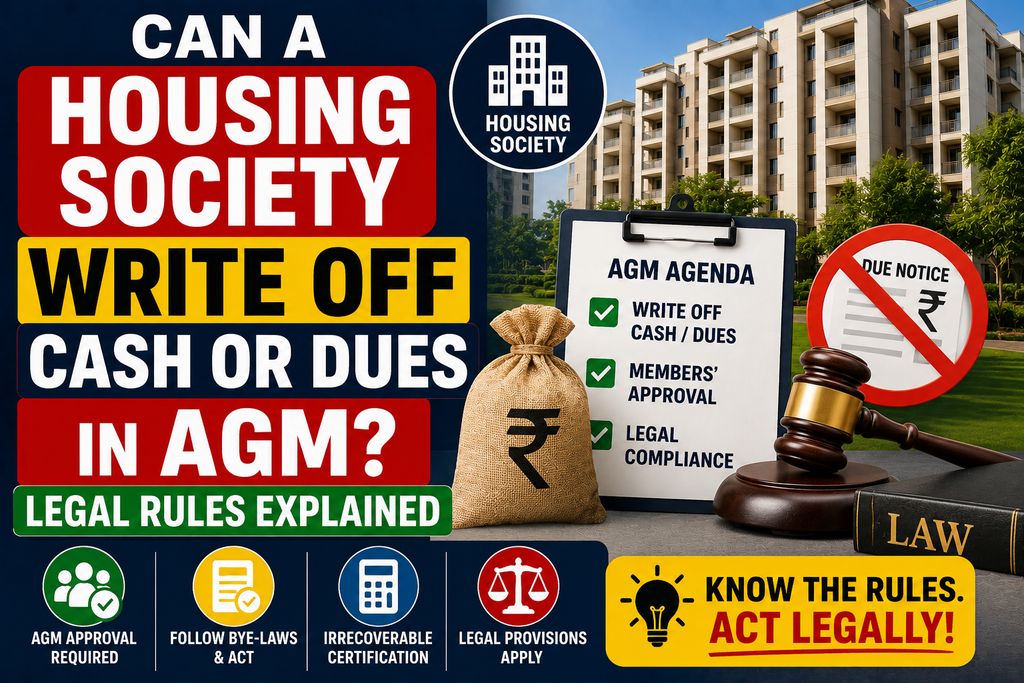
Many cooperative housing societies face situations where old outstanding dues, bad debts, or accumulated losses remain unrecoverable despite repeated recovery efforts. In such cases, members often wonder whether the Annual General Meeting (AGM) has the authority to pass a resolution and simply write off the amount from the society’s books.
The answer is yes, but only after complying with the legal procedure prescribed under the Maharashtra Cooperative Societies framework and the society’s bye-laws. A mere AGM resolution by itself is not enough.
Can the General Body Approve a Write-Off?
The general body of a cooperative housing society has the power to approve the write-off of certain amounts, including:
- Irrecoverable society charges due from members
- Expenses incurred for recovery proceedings
- Accumulated losses that have become impossible to recover
However, this power is subject to compliance with the provisions of the society’s bye-laws and approval from the competent authorities wherever required.
AGM Resolution Alone Is Not Sufficient
Even if the members pass a unanimous resolution during the AGM approving the write-off, the decision does not automatically become legally valid.
The write-off must satisfy specific legal conditions before it can be implemented.
Therefore, societies should avoid removing entries from their books merely because the AGM has approved the proposal.
Certification That the Amount Is Irrecoverable
Before any write-off is considered, the losses or dues should be certified as irrecoverable by the duly appointed statutory authority.
This ensures that societies do not arbitrarily waive recoverable amounts and protects the financial interests of all members.
Registrar’s Approval Is Mandatory
Under Bye-laws 149 and 150, the approval of the Registrar (the registering authority) is required before the society can legally write off society charges or accumulated losses.
Without obtaining this approval, the write-off process remains incomplete and may be questioned during statutory audits or inspections.
What If the Society Has Outstanding Loans?
If the cooperative housing society is indebted to a financial institution, an additional safeguard applies.
In such circumstances:
- The approval of the concerned financial institution is required before writing off the amount.
- This prevents any action that could adversely affect the interests of the lender.
When Permission from the Bank Is Not Required
If the society is merely affiliated with a District Central Cooperative Bank or another financial agency but has no outstanding debt towards it, then permission from that bank or agency is not necessary.
Only societies that are actually indebted must obtain such approval.
Why Proper Procedure Is Important
Writing off dues affects the society’s financial statements and members’ interests. Following the prescribed legal process ensures:
- Transparency in financial management
- Proper accounting treatment of bad debts
- Compliance with statutory audit requirements
- Protection against future legal disputes
- Accountability of the managing committee
Improper write-offs may attract objections from auditors or regulatory authorities.
Practical Advice for Managing Committees
Before deciding to write off any amount, the managing committee should:
- Verify that all reasonable recovery efforts have been exhausted.
- Obtain certification that the amount is genuinely irrecoverable.
- Place the proposal before the general body for approval.
- Seek approval from the Registrar as required under the bye-laws.
- Obtain consent from any lending financial institution if the society is indebted.
- Maintain complete records of all resolutions, correspondence, and approvals for audit purposes.
Conclusion
A cooperative housing society cannot legally write off cash, member dues, or accumulated losses solely on the basis of an AGM resolution. While the general body has the authority to approve such proposals, the write-off must also comply with Bye-laws 149 and 150, including obtaining the Registrar’s approval and, where applicable, the consent of the concerned financial institution. Following the prescribed procedure protects the society from audit objections and ensures that financial decisions remain legally valid and transparent.