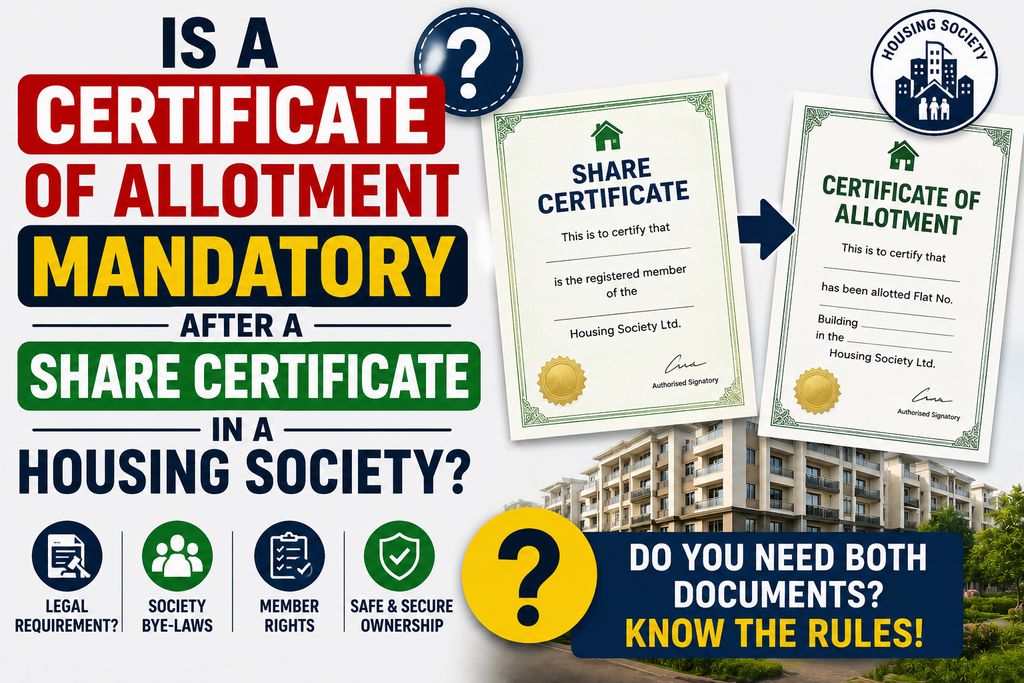
Many members of cooperative housing societies are confused about the difference between a Certificate of Allotment and a Share Certificate. Some believe that both documents are mandatory and should be issued by the society, while others consider the share certificate sufficient proof of membership and ownership. Understanding the distinction between these two documents is essential to determine whether a society is legally required to issue a Certificate of Allotment after the share certificate has already been issued.
What Is a Certificate of Allotment?
A Certificate of Allotment is generally issued during the initial stages of a housing project where members jointly come together to form a cooperative housing society, acquire land, and undertake construction.
It is typically issued:
- Before the execution and registration of the agreement for sale.
- At the booking or allotment stage of a flat, plot, or dwelling unit.
- To confirm the provisional entitlement of a member to a specific property and the corresponding shares.
The certificate records the terms of allotment, payment conditions, and the member’s right to occupy the allotted unit once the project is completed.
Purpose of a Certificate of Allotment
The Certificate of Allotment serves several important functions during the early stages of a project:
- Confirms provisional allocation of a flat or plot.
- Protects members who have contributed funds towards land acquisition and construction.
- Records the initial allotment of shares attached to the unit.
- Acts as evidence of entitlement before execution of a registered agreement.
It is particularly relevant where no registered conveyance or sale agreement has yet been executed.
What Is a Share Certificate?
A Share Certificate is the official document issued by a cooperative housing society to its members after allotment.
Unlike a Certificate of Allotment, it is the final document evidencing:
- Membership of the society.
- Ownership of the allotted shares.
- Voting rights within the society.
- Entitlement to common facilities.
- Recognition as a lawful member under the society’s records.
The share certificate must ordinarily be issued within six months from the allotment of shares and should also be endorsed whenever ownership is transferred.
Difference Between Certificate of Allotment and Share Certificate
Certificate of Allotment
- Issued at the preliminary stage of the project.
- Confirms provisional entitlement.
- Applicable before registration of the agreement.
- Protects members pending formal documentation.
Share Certificate
- Issued after allotment is completed.
- Establishes legal membership in the society.
- Serves as proof of ownership of society shares.
- Continues throughout the period of membership and is transferred upon sale of the flat.
Is It Mandatory to Issue a Certificate of Allotment After the Share Certificate?
No.
Once the society has been duly formed and a Share Certificate has been issued to the member, there is ordinarily no requirement to separately issue a Certificate of Allotment.
The share certificate itself becomes the conclusive document evidencing:
- Membership,
- Shareholding,
- Rights in the cooperative housing society, and
- Associated property rights.
Therefore, where a valid share certificate has already been issued, insisting upon a Certificate of Allotment is generally unnecessary.
Section 154B-10(2) of the MCS Act
Section 154B-10(2) of the Maharashtra Cooperative Societies Act, 1960 deals with the issuance of a Certificate of Allotment in appropriate situations.
However, the provision is primarily intended for societies involved in allotting plots or dwelling units during project development. It does not create an obligation to issue a fresh Certificate of Allotment where the society is fully operational and has already issued a valid share certificate to the member.
Is the Society Justified in Refusing the Request?
Yes.
If the member already possesses a duly issued share certificate, the managing committee is justified in taking the view that no separate Certificate of Allotment is required.
The share certificate adequately establishes:
- Membership in the cooperative housing society.
- Ownership of the allotted shares.
- Rights attached to the flat within the society.
Accordingly, the refusal to issue an additional Certificate of Allotment would generally be legally sustainable.
Conclusion
A Certificate of Allotment and a Share Certificate serve different purposes in a cooperative housing project. The Certificate of Allotment is a provisional document issued during the early stages of development before execution of registered agreements, whereas the Share Certificate is the final legal document proving membership and share ownership in the society. Once a valid share certificate has been issued, the society is generally not required to issue a separate Certificate of Allotment, and the managing committee’s decision to decline such a request is ordinarily justified.