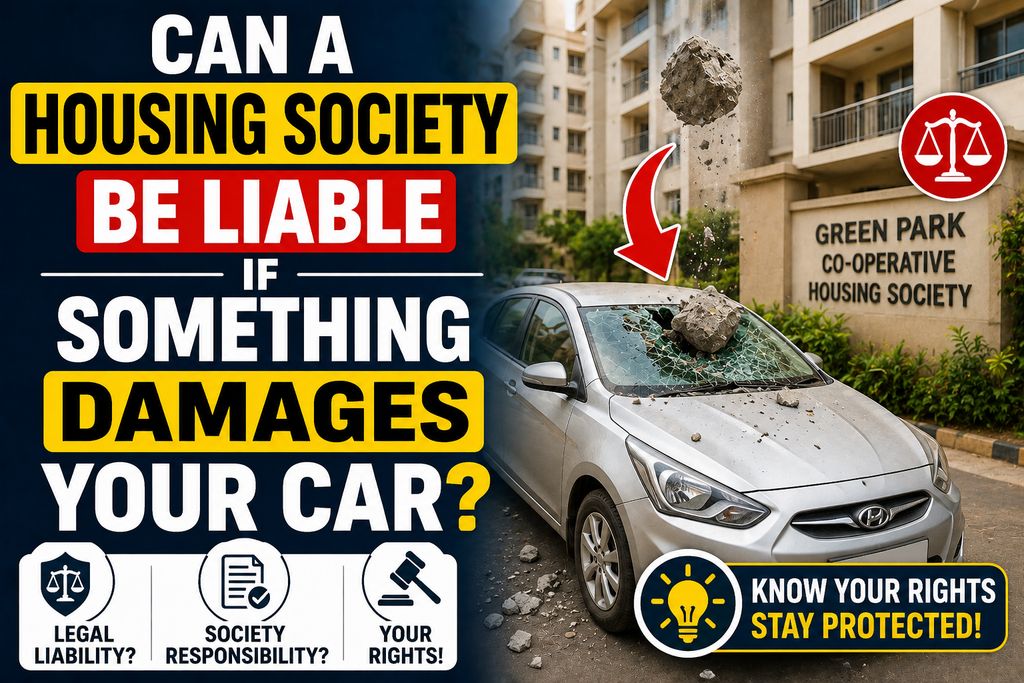
Heavy rains and storms during monsoon often expose safety risks within housing society premises. One common issue is damage caused by falling tree branches due to lack of timely trimming and maintenance. In many cases, residents repeatedly warn the managing committee about dangerous branches, but preventive action is delayed until an accident occurs.
If a tree branch falls on a parked car and causes damage, the question naturally arises whether the housing society can be held responsible for the loss.
Managing Committee’s Responsibility for Tree Maintenance
Under Bye-law 155, the managing committee is responsible for the upkeep, safety, and maintenance of the society premises. This responsibility includes monitoring trees located within the compound and taking preventive steps if any branches pose danger to:
- Residents,
- Vehicles,
- Buildings, or
- Other property.
The committee is expected to inspect trees before monsoon and take precautionary measures such as trimming weak or overgrown branches.
However, before cutting or trimming trees, the society is generally required to obtain prior permission from the municipal authority such as the Brihanmumbai Municipal Corporation (BMC).
Individual members are not permitted to independently cut or damage trees situated in common areas.
Can the Society Be Held Liable for Car Damage?
If the member had repeatedly informed the society about the dangerous condition of the tree and the managing committee failed to act despite notice, the society may be exposed to liability for negligence.
Important factors that may determine liability include:
- Whether prior complaints were made,
- Whether the committee ignored warnings,
- Whether reasonable precautions were taken before monsoon,
- Whether the tree was visibly dangerous or weak.
In such cases, the member can:
- Submit a written claim to the society,
- Demand reimbursement for repair expenses,
- Place the matter before the general body,
- Seek compensation through legal proceedings if necessary.
The society may attempt to defend itself by arguing that the incident was caused by a natural calamity or an unavoidable act of nature. However, failure to take preventive action despite repeated complaints may weaken such a defence.
Importance of Written Complaints
Members should always communicate such concerns in writing through:
- Email,
- Letter,
- Society complaint register,
- WhatsApp group where officially recognised.
Written evidence becomes important if compensation is later claimed.
If the member had already warned the committee before the accident, those records may help establish negligence.
Can the Member Approach Consumer Court or Cooperative Court?
If the society refuses to compensate the member despite clear negligence, the affected resident may consider:
- Filing a complaint before the cooperative court,
- Approaching the consumer commission for deficiency in service,
- Seeking damages for negligence.
The outcome would depend on the facts, evidence, and extent of negligence established.
Insurance Coverage and Practical Considerations
Many vehicle owners assume that standard motor insurance covers all forms of damage. However, certain policies may exclude:
- Natural calamities,
- Falling objects,
- Tree damage,
- Flood-related damage,
unless specific add-on covers are taken.
Residents should consider comprehensive insurance policies that include:
- Storm damage,
- Tree fall damage,
- Flood coverage,
- Natural calamity protection.
This helps reduce financial exposure during monsoon-related incidents.
Preventive Measures Housing Societies Should Take
To avoid accidents and legal disputes, societies should:
- Conduct pre-monsoon inspections,
- Identify weak branches and risky trees,
- Obtain BMC permission for trimming,
- Maintain records of complaints and action taken,
- Create a tree maintenance schedule.
Regular preventive maintenance protects both residents and the society from unnecessary liability.
Conclusion
Housing societies have a legal responsibility to maintain common areas and ensure that trees within the premises do not pose danger to life or property. If a managing committee ignores repeated warnings about unsafe tree branches and damage occurs, the society may be held accountable for negligence.
Residents should maintain written records of complaints and pursue compensation through appropriate legal remedies if genuine negligence can be established.