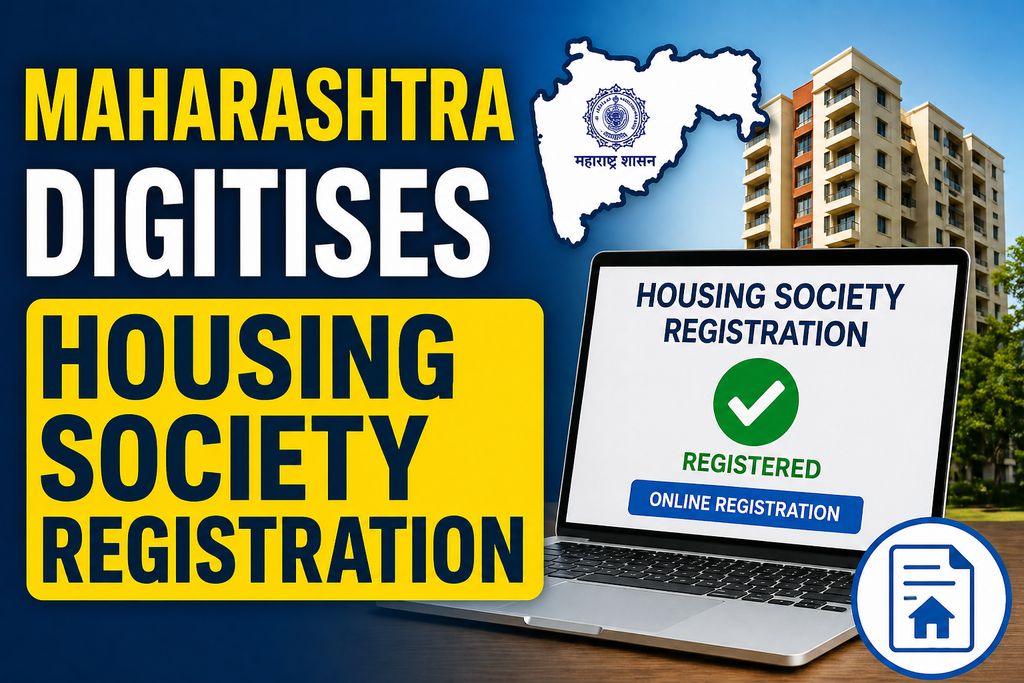
In a major reform aimed at simplifying governance, the Maharashtra government has digitised the registration process of cooperative housing societies, making it faster, transparent, and far less cumbersome for residents.
The initiative has been rolled out through the
Aaple Sarkar Portal
bringing an end to excessive paperwork and repeated visits to government offices.
Key Highlights of the New Digital System
1. Reduction in Documents (29 to 19)
One of the biggest reliefs for applicants is:
- Mandatory documents reduced from 29 to 19
- Removal of 10 non-essential documents, such as:
- Zoning certificates
- Title search reports
- Development agreements
- Business projection plans
However, the government has retained critical documents like:
- Land ownership proof
- Construction approvals
- Promoter details
- Registered agreements
This ensures legal validity is not compromised.
2. Fully Online Process – No More Office Visits
The entire workflow is now digitised:
- Online application submission
- Document upload
- Real-time tracking of application status
This eliminates:
- Physical paperwork
- Dependency on middlemen
- Frequent visits to registrar offices
3. Time-Bound Approval: Within 2 Months
A major improvement is the fixed timeline:
- Registration process must be completed within 60 days
- Ensures accountability and faster approvals
4. Online Payment Integration
The system is integrated with the government payment gateway:
- Registration fee: ₹2,500
- Paid through
Government Receipt Accounting System (GRAS)
This adds transparency and ease of payment.
5. Covers New Registrations and Bye-law Amendments
The platform is not limited to new societies:
- Applicable to all cooperative societies
- Also allows:
- Amendment of bye-laws
- Updates to society records
Why This Reform Is Important
1. Tackling Unregistered Buildings
Currently:
- Around 1.25 lakh societies are registered
- But lakhs of buildings remain unregistered
Reasons include:
- Complex procedures
- Builder non-cooperation
- Document-related hurdles
The new system directly addresses these issues.
2. Empowering Residents
Once registered, a society can:
- Manage finances independently
- Undertake repairs and maintenance
- Apply for deemed conveyance
- Access government schemes and services
Role of the Cooperation Department
The reform has been spearheaded by the
Maharashtra Cooperation Department
Officials have emphasized that:
- The goal is to reduce red tape
- Ensure efficiency and transparency
- Protect residents from exploitation by middlemen
Early Response and Progress
Since its launch:
- 43 applications received
- 14 approved for processing
- 3 under scrutiny
This indicates growing adoption of the system.
Safeguards Still in Place
Despite simplification:
- Legal scrutiny remains intact
- Only repetitive and non-essential documents removed
- Core verification continues
This ensures a balance between:
- Ease of doing compliance
- Legal protection
Conclusion
The digitisation of housing society registration in Maharashtra marks a significant shift towards ease, transparency, and efficiency. By reducing documentation, introducing online processing, and ensuring time-bound approvals, the government has made it much easier for residents to formalise their societies.
This reform is especially beneficial for cities like Mumbai and Pune, where thousands of buildings are still awaiting registration. It not only simplifies procedures but also empowers residents to take control of their housing societies without unnecessary delays or dependency on intermediaries.