
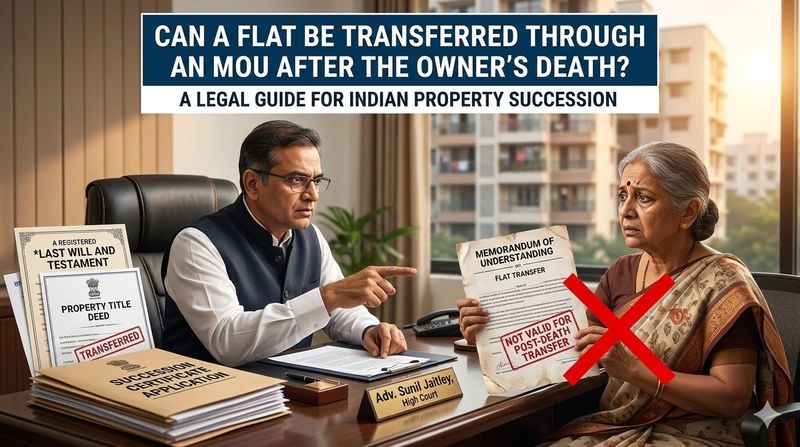
Disputes often arise in cooperative housing societies when a member passes away without clear succession arrangements. Sometimes third parties claim ownership based on private agreements or memorandums of understanding (MoU). However, housing society membership and ownership transfer are governed by specific legal provisions.
Understanding the legal framework under the Maharashtra Co-operative Societies Act, 1960 is essential to determine whether such claims are valid.
Effect of Death on a Partnership Firm
In this case, the deceased member and her brother-in-law were partners in a firm. Under partnership law, when a firm consists of only two partners, the partnership automatically comes to an end upon the death of one partner unless there is an agreement stating otherwise.
Therefore, after the death of the member, the partnership firm ceased to exist. Any action taken later by the surviving partner regarding property owned by the deceased must be supported by legal authority or ownership rights.
Can the Brother-in-Law Transfer the Flat?
The brother-in-law entered into a Memorandum of Understanding (MoU) with a creditor of the firm to settle the loan by handing over the flat. However, such an arrangement is not legally valid unless the brother-in-law had legal authority over the property.
If there is no registered document authorising him to transfer the flat, the MoU cannot create ownership rights in favour of the creditor or occupier.
Possession vs Ownership
It is important to understand the legal difference between possession and ownership.
A person may occupy the flat and even pay:
-
Maintenance charges
-
Utility bills
-
Society dues
But occupation alone does not confer ownership.
Ownership of a flat in a cooperative housing society can only be transferred through legally recognised documents such as:
-
Registered Agreement for Sale
-
Gift Deed
-
Release or Relinquishment Deed
-
Other legally valid transfer documents
Without such documents, the occupier cannot claim ownership or membership.
Legal Process for Transfer After Death of a Member
The law clearly provides the method for transferring the shares, rights and interest of a deceased member.
Under Section 154B-13 of the Maharashtra Co-operative Societies Act, 1960, transfer of the property after the death of a member can be done on the basis of:
-
Will or testamentary document
-
Succession certificate
-
Legal heirship certificate
-
Family arrangement document executed by legal heirs
Additionally, if the deceased member had made a nomination, the nominated person may also claim membership rights subject to legal procedures.
Why an MoU Is Not Valid for Transfer
A Memorandum of Understanding (MoU) does not appear among the legally recognised documents for transfer of ownership in cooperative housing societies.
Therefore:
-
The MoU executed by the brother-in-law cannot transfer ownership of the flat.
-
The person occupying the flat cannot be admitted as a member of the society based solely on the MoU or payment of maintenance charges.
Steps the Society Should Take
The managing committee should take a cautious approach and request valid legal documents before admitting any new member.
The society should:
-
Ask the occupier to produce valid transfer documents recognised by law.
-
Verify whether the deceased member had any nomination registered with the society.
-
Identify and contact legal heirs, if any, to resolve the ownership issue.
Until proper documentation is provided, the occupier should be treated only as an occupant, not a member or owner.
Conclusion
A Memorandum of Understanding executed by a surviving partner cannot legally transfer ownership of a flat belonging to a deceased member. Payment of maintenance charges or physical possession does not establish ownership rights. Under the Maharashtra Cooperative Societies Act, transfer of property after a member’s death must be supported by legally recognised documents such as a will, succession certificate, legal heirship certificate or family settlement. Societies must insist on proper documentation before admitting any occupant as a member to avoid future legal disputes.