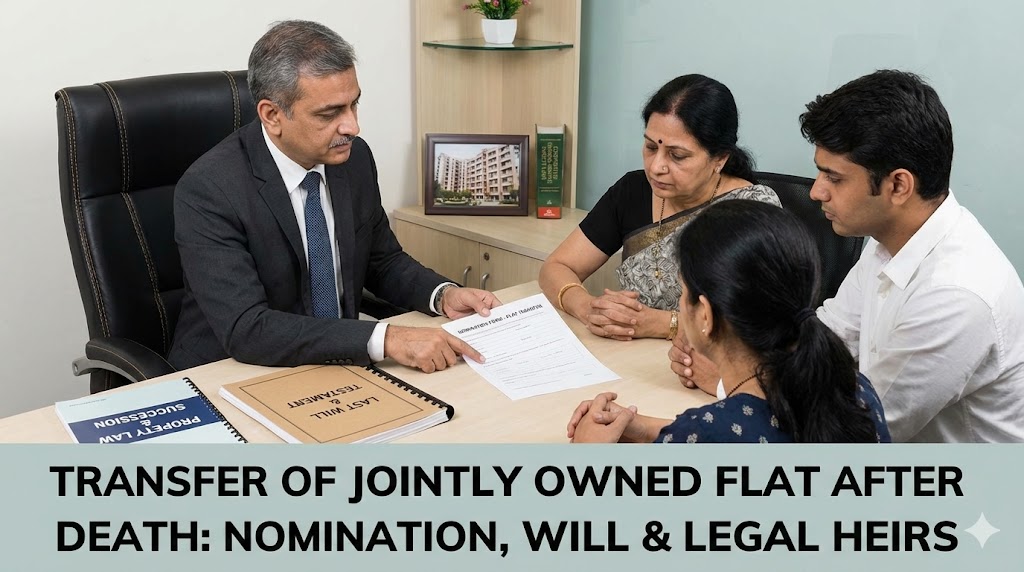
In many housing societies, disputes arise when a joint flat owner passes away, especially where legal heirs are estranged and a third party has been nominated or named in a Will. Your case involves all three elements — joint ownership, nomination mentioned in the purchase agreement, and a Will in your favour — which requires careful legal handling to ensure a peaceful transfer of ownership.
Joint Ownership and Rights After Death of One Owner
Where a flat is jointly owned, the rights of parties after the death of one co-owner depend on:
• the mode of holding (joint tenancy or tenancy-in-common),
• the society records, and
• compliance with the Maharashtra Cooperative Societies (MCS) Act and Bye-laws.
Even though you were a joint purchaser, the share of the deceased owner does not automatically vest in the surviving joint owner unless supported by proper legal documentation recognised by the society.
Nomination Mentioned in Purchase Agreement – Legal Limitation
Although the purchase agreement contains a nomination clause in your favour, this alone does not fulfil the statutory requirement under society laws.
Bye-law 32 clearly provides that:
• Nomination must be submitted in the prescribed form,
• It must be filed in triplicate,
• One copy must be acknowledged by the society, and
• Details must be entered in the Nominee Register maintained by the society.
In your case, since no formal nomination form was submitted to the society, there is no valid nomination on record under the MCS Act. A nomination merely mentioned in a private agreement between buyer and seller does not bind the society.
Role of the Will and Risk of Objection by Legal Heirs
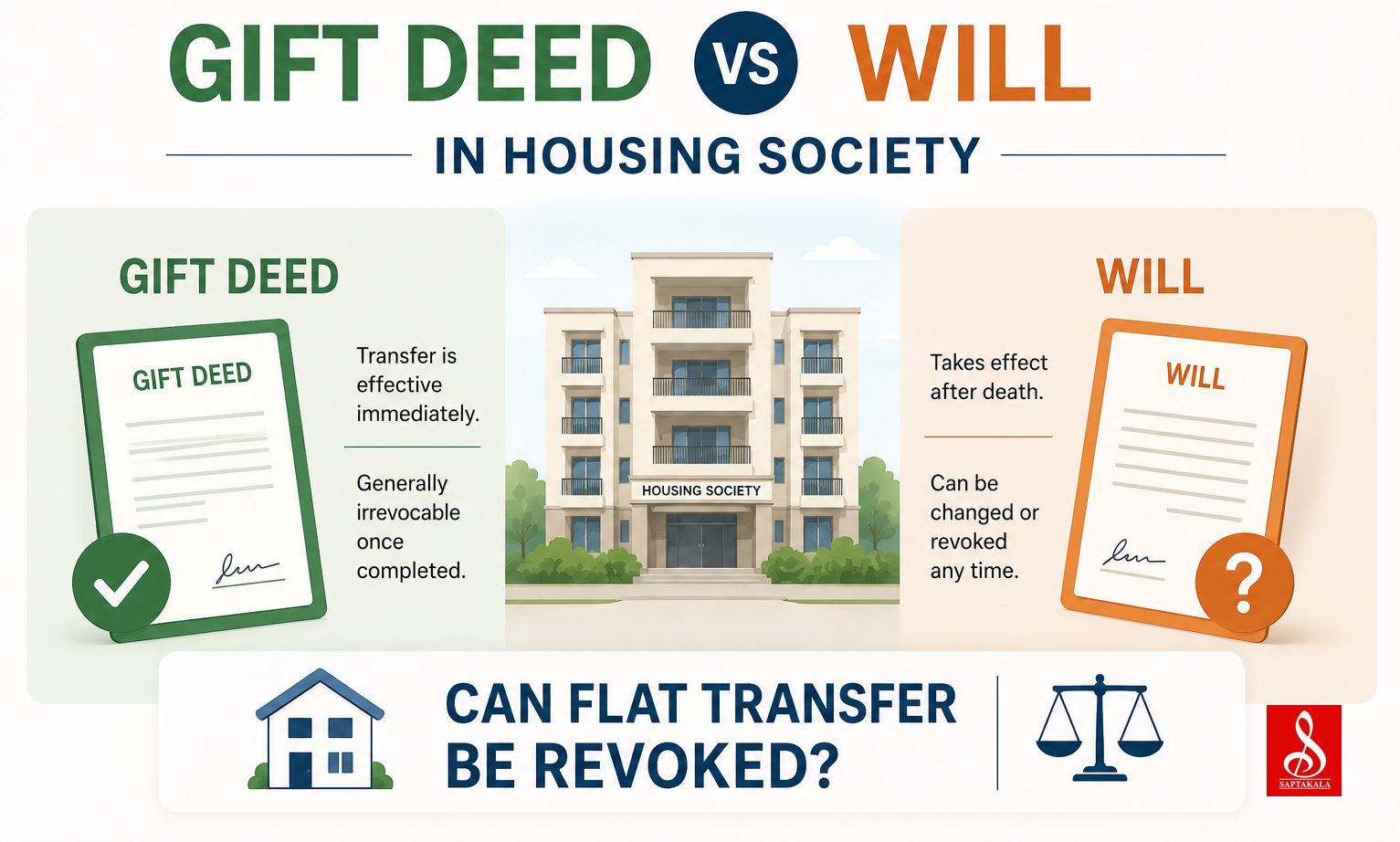
A Will has precedence over nomination when it comes to succession. However, legal heirs always retain the right to challenge a Will unless it is probated.
Even if the heirs were negligent or estranged, they can still:
• raise objections before the society, or
• challenge the transfer before a competent court.
Hence, without probate, the managing committee may be hesitant to transfer the deceased member’s share solely based on the Will.
Why Probate Is the Safest Route
To eliminate all future disputes and objections, it is strongly advisable to obtain a Probate of the Will from the competent court.
Once probate is granted:
• The Will attains legal finality,
• Legal heirs lose the right to object, and
• The society is legally empowered to act on it.
Upon submission of the probate order, the managing committee can lawfully strike off the deceased member’s name and transfer his entire share to you, making you the sole owner of the flat.
This process is supported by Section 154B-13 of the MCS Act, which empowers the society to act on valid succession documents.
Practical Steps You Should Take
To ensure a smooth and dispute-free transfer, you should:
• Apply for probate of the Will at the earliest
• Submit the probate order to the society
• Request deletion of the deceased member’s name from records
• Apply for transfer of shares in your sole name
Until probate is obtained, the society may at best grant you provisional membership, but full ownership transfer may remain vulnerable to challenge.
Key Takeaway
While your care and contribution are morally significant, legal certainty comes only through probate. Relying solely on a nomination clause in an agreement or an unprobated Will may expose you to future litigation. Probate is the most effective shield against objections from legal heirs.