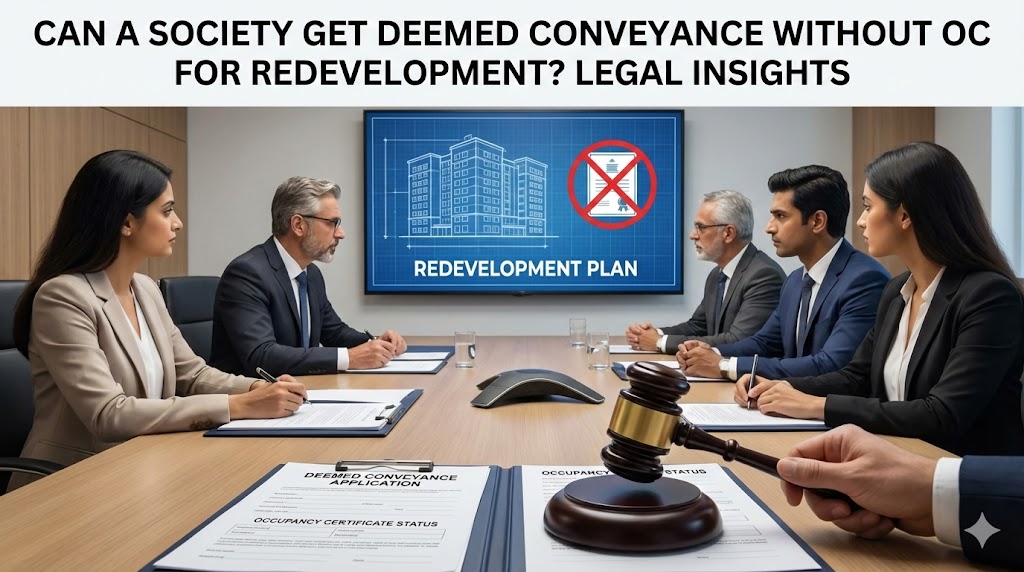
Many housing societies across Mumbai face redevelopment hurdles because either the Occupancy Certificate (OC) or Conveyance is missing. The key question is whether redevelopment can proceed in such circumstances.
Let us examine the legal position in detail.
Is Conveyance Mandatory for Redevelopment?
Yes. Conveyance is essential before undertaking redevelopment.
Conveyance means the transfer of right, title and interest in the land and building from the promoter (builder/landowner) to the society. Once conveyance is executed:
-
The society becomes the legal owner of the land and structure
-
It gains authority to appoint a developer
-
It can legally execute a redevelopment agreement
Under the Maharashtra Ownership Flats Act, 1963 (MOFA), the promoter is obligated to execute conveyance within four months of project completion.
However, thousands of societies in Maharashtra still do not have conveyance due to builder inaction or avoidance.
Without conveyance, redevelopment becomes legally vulnerable because the society does not hold clear title to the land.
What If the Builder Is Deceased?
If the original developer is deceased, the society can still proceed with Deemed Conveyance.
The law provides a remedy where:
-
The builder fails to execute conveyance
-
The builder is untraceable
-
The builder is deceased
In 2008, an amendment to MOFA introduced the concept of Deemed Conveyance, allowing societies to obtain title transfer through the District Deputy Registrar (DDR) without the builder’s cooperation.
Therefore, the death of the developer does not prevent the society from securing ownership rights.
Is Occupancy Certificate (OC) Mandatory for Deemed Conveyance?
No. An Occupancy Certificate is not a prerequisite for Deemed Conveyance.
A Government Resolution dated 22 June 2018 clarified that:
-
Societies without OC can apply for Deemed Conveyance
-
A self-declaration undertaking to obtain OC or regularise the building at their own cost is sufficient
This legal position has also been judicially upheld.
In the case of ALJ Residency CHSL v State of Maharashtra decided by the Bombay High Court on 25 November 2024:
-
The society did not have an OC
-
The Commencement Certificate was only up to plinth level
-
Even demolition notices were issued earlier
The DDR rejected the Deemed Conveyance application citing absence of OC.
However, the High Court set aside the rejection and directed the DDR to grant Deemed Conveyance, ruling that OC is not a precondition.
The decision was subsequently affirmed by the Supreme Court of India.
This landmark judgment has strengthened the rights of societies lacking OC.
How Long Does the Deemed Conveyance Process Take?
The procedure has been simplified significantly:
-
Application fee: ₹2,000
-
Maximum timeline prescribed: six months
-
Documents required reduced from 12 to 8 (post 2018 reforms)
-
Online filing available via the PRATYAY Mahabhumi portal
Although practical timelines may vary depending on documentation and objections, the government has prescribed a six-month disposal period.
Can Redevelopment Proceed Without Conveyance?
Practically and legally, redevelopment should not proceed without conveyance because:
-
The society must have clear and marketable title
-
Developers insist on title clarity
-
Financial institutions require ownership proof
Therefore, obtaining Deemed Conveyance is the first crucial step before initiating redevelopment.
Steps the Society Should Take
-
Pass a Special General Body Resolution approving application for Deemed Conveyance.
-
Appoint a legal expert experienced in MOFA matters.
-
File application before the DDR with required documents.
-
Obtain conveyance order and register the Conveyance Deed.
-
Thereafter, initiate redevelopment process as per law.
Key Takeaways
-
Conveyance is mandatory for redevelopment.
-
OC is not mandatory for Deemed Conveyance.
-
Builder’s death does not block the process.
-
High Court and Supreme Court have clarified the law.
-
Government timeline for Deemed Conveyance is six months.
Conclusion
Societies without Occupancy Certificate or builder cooperation should not feel stuck. The law under MOFA provides a practical and judicially supported solution through Deemed Conveyance. Securing title in the society’s name is the foundational step before embarking on redevelopment. Proper legal guidance and timely action can resolve the issue efficiently.