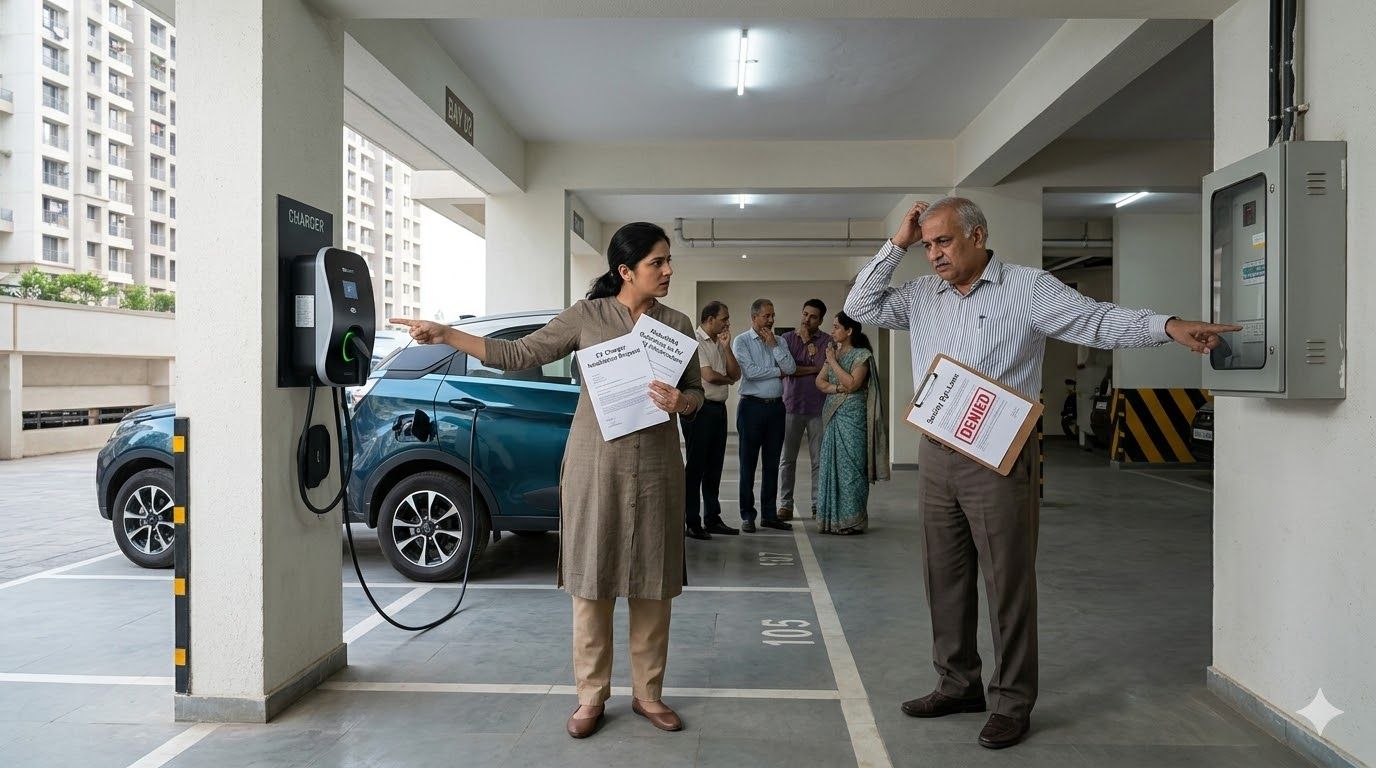
With the rapid adoption of electric vehicles (EVs), many residents now seek to install charging points in their society parking spaces. However, delays or non-response from managing committees often create confusion. The law and government guidelines provide clarity on what you can do.
Government Guidelines on EV Charging
To promote EV adoption, the Ministry of Power issued revised guidelines on 14 January 2022, allowing EV owners to charge vehicles at their residence or workplace using existing electricity connections.
This means:
-
You do not need society approval to own an EV or charge it
-
You can use your existing electricity meter for charging
-
Societies are expected to facilitate, not obstruct, EV adoption
Can Society Deny Permission?
A housing society cannot unreasonably deny or delay installation of an EV charging point, especially when:
-
The installation is within your allotted parking space
-
You comply with safety and electrical norms
-
There is no risk to common infrastructure
Non-response for months may be treated as unjustified obstruction.
What You Should Do as an EV Owner
To proceed smoothly and avoid disputes, follow a structured approach:
1. Inform the Society in Writing
Submit a written application stating:
-
You will install the charger from your own electricity meter
-
You will follow all safety guidelines and SOPs
-
The installation will not damage common property
Attach reference to government EV guidelines.
2. Ensure Electrical Safety Compliance
Follow safety norms issued by:
-
Chief Electrical Inspector
-
Central Electricity Authority
Key safety requirements include:
-
Installation of RCCB/ELCB (Residual Current/Earth Leakage Circuit Breaker)
-
Use of IEC 60309 industrial connectors
-
Proper insulated cabling and routing
Safety compliance is crucial to avoid fire or electrical hazards.
3. Check Load Capacity
EV charging increases electricity load. You must:
-
Calculate required load (based on charger capacity)
-
Apply to your distribution licensee if load enhancement is needed
Typical charging setups:
-
230V/15A socket – slower charging (10–15 hours)
-
7.5 kW charger – faster charging
Consult your car dealer or electrical consultant for correct specifications.
4. Metering Options
You have two options:
-
Use your existing home meter (simplest method)
-
Apply for a separate electricity meter with society’s intimation
Electricity consumption will be billed directly to you.
Why Societies Should Support EV Charging
Encouraging EV charging infrastructure benefits all residents:
-
Reduces air and noise pollution
-
Increases property value and modernisation
-
Prepares society for future demand
The Bombay High Court has also observed that EV charging infrastructure is essential for reducing pollution and should be supported through proper legal frameworks.
Organizations like Mumbai Grahak Panchayat have even recommended making EV charging provisions mandatory in housing societies.
What If Society Still Does Not Cooperate?
If the managing committee continues to ignore your request:
-
Send a formal reminder notice citing government guidelines
-
Raise the issue in the General Body Meeting
-
Approach the electricity distribution company for technical approval
-
As a last resort, file a complaint with the Deputy Registrar of Cooperative Societies
Conclusion
As an EV owner, you have the right to install a charging point in your parking space using your own electricity connection, provided you follow safety and technical norms. Housing societies should facilitate such installations rather than delay them. With proper communication, compliance and awareness of legal provisions, EV charging in societies can be implemented smoothly and safely.