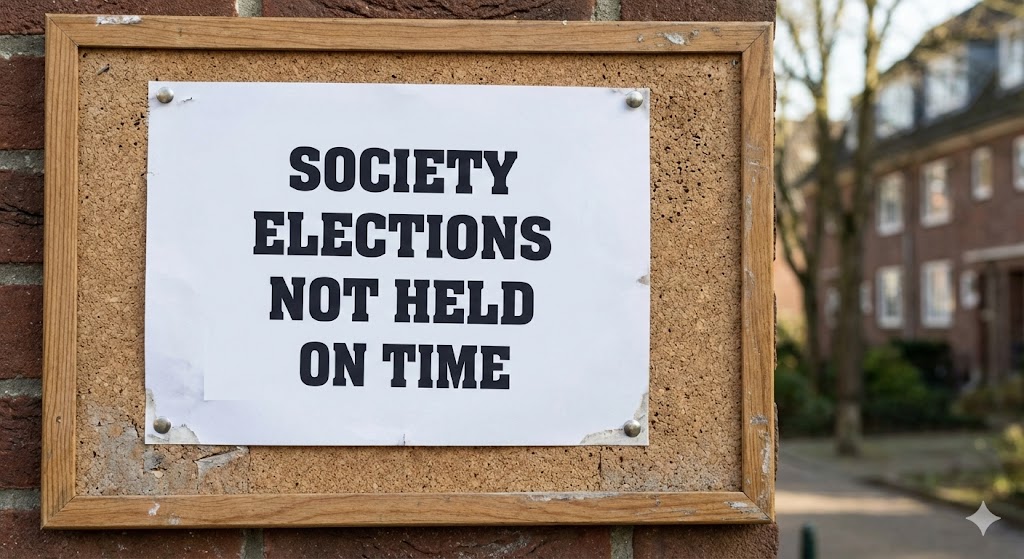
Elections to the managing committee of a cooperative housing society are not a formality but a statutory obligation. The tenure of the managing committee is fixed, and democratic functioning of the society depends on free and fair elections conducted within time. Any delay defeats the very purpose of cooperative governance.
Statutory Duty of the Managing Committee
The managing committee is required to:
• Intimate the Registrar / State Cooperative Election Authority at least six months before expiry of its term, and
• Initiate the election process well in advance so that a new committee is elected before the existing term ends.
Failure to follow this process is considered a serious lapse and attracts action under the Maharashtra Cooperative Societies Act (MCS Act).
What Happens If Elections Are Not Conducted Before Expiry of Term?
If the managing committee fails to conduct elections before the expiry of its term:
• the committee automatically ceases to hold office,
• it loses authority to take policy decisions, and
• the Registrar can step in, appoint an administrator, or pass other appropriate orders.
Any member of the society can file a complaint with the Registrar highlighting the failure to conduct elections, upon which necessary action will be initiated.
Can the Same Committee Members Contest the Subsequent Election?
Yes, mere failure to conduct elections on time does not automatically disqualify the outgoing committee members from contesting again.
The outgoing committee members:
• can contest the subsequent election,
• provided they do not suffer from any statutory disqualification under the MCS Act or bye-laws (such as default in dues, disqualification under Section 154B-23, etc.).
However, it is important to note that:
• the right to contest does not guarantee re-election, and
• it is entirely the members of the society who decide whether such committee members deserve another term.
Members’ Democratic Right
Ultimately, the general body is the supreme authority. If members believe that the committee acted irresponsibly by failing to hold elections in time, they may:
• choose not to re-elect them, or
• elect a new and more responsible committee.
Thus, while the law allows them to contest, accountability lies in the hands of the members.
Consequences Faced by the Outgoing Committee
Even if they are allowed to contest again, the outgoing committee may still face:
• administrative action by the Registrar,
• possible adverse remarks or penalties, and
• loss of trust and credibility among members.
Timely elections are therefore not just a legal requirement but also a measure of good governance.
Conclusion
Failure to conduct elections before the expiry of the term results in the committee vacating office and facing registrar action. However, the same members are not barred from contesting again, unless specifically disqualified under law. The final verdict always rests with the members of the society, who decide through the ballot whether such committee members should be given another chance.