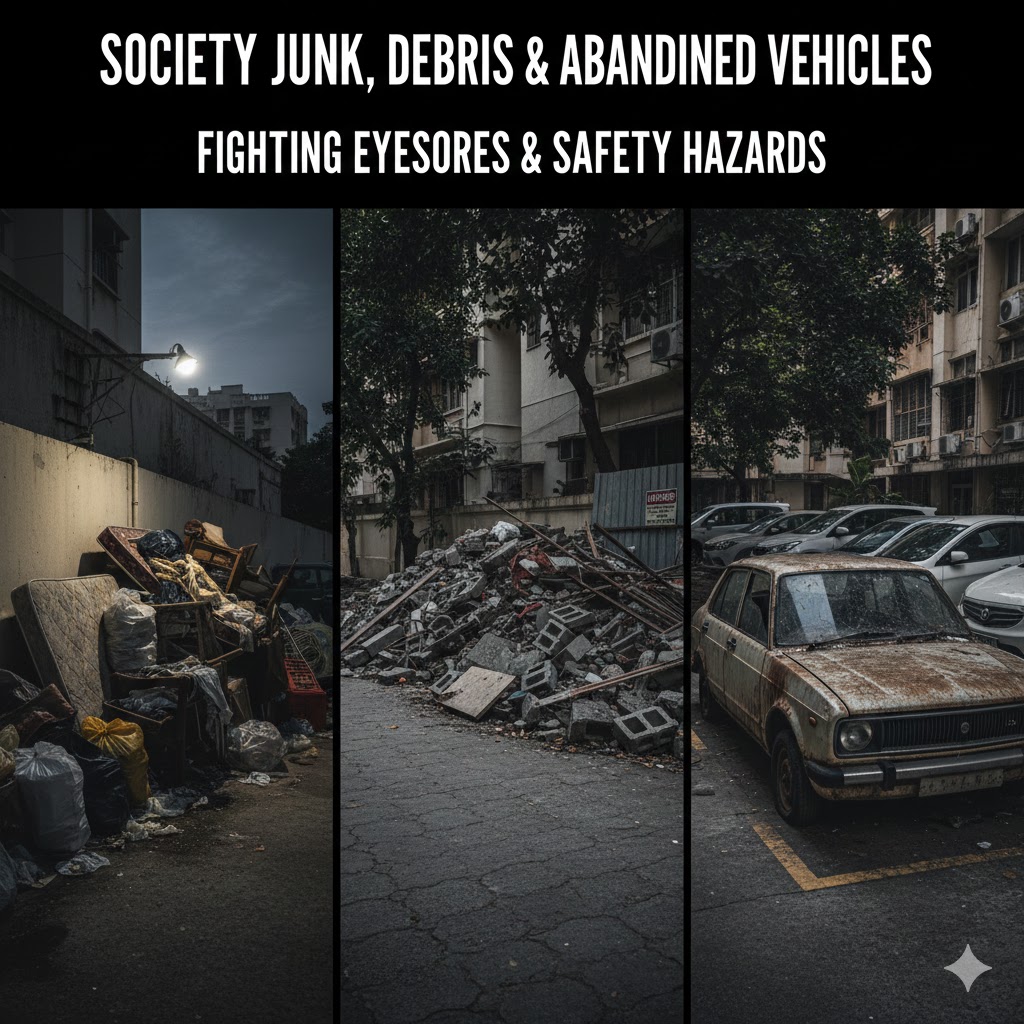
Accumulation of construction waste, unused vehicles and junk in common areas is not merely an inconvenience — it poses serious health and safety risks, including infestation by rodents and snakes. Cooperative housing societies are legally empowered to act against such violations under the Model Bye-laws.
A clean environment is both a fundamental right of residents and a collective responsibility.
Responsibility of Members Undertaking Renovation
Any member carrying out:
-
Renovation
-
Structural changes
-
Interior modifications
must do so after obtaining permission from the society and, wherever required, from the municipal authority.
Further, construction and demolition (C&D) waste must be:
-
Segregated at source
-
Disposed of through the municipal authority or authorised paid service
Open or common spaces cannot be used indefinitely to store construction debris.
Use of Common Areas Is Not a Right
Common areas such as:
-
Stilt spaces
-
Open compounds
-
Driveways
-
Parking passages
are meant for collective use. Occupying them for personal storage beyond a reasonable period amounts to encroachment.
The managing committee should:
-
Give reasonable time for removal of debris
-
Issue a written notice directing clearance
Penalty for Non-Compliance – Bye-law 169
If the member fails to remove construction waste despite notice, the society may levy a penalty up to five times the monthly maintenance charges for the period of continued default, as per Bye-law 169.
This provision acts as a deterrent against misuse of common spaces.
Recovery of Removal Costs
If non-compliance continues, the committee may:
-
Arrange for removal of construction waste on its own
-
Recover the actual cost incurred from the defaulting member
The cost can be added to the member’s dues and recovered accordingly.
Action Against Abandoned or Unused Vehicles
Unused or junk vehicles parked within the society create:
-
Hygiene hazards
-
Space constraints
-
Safety concerns
The committee should:
-
Issue written intimation to owners
-
Direct removal within a specified period
The society should also have a General Body-approved parking policy covering:
-
Allotment criteria
-
Periodic cleaning requirements
-
Removal of unused vehicles
-
Penalty for violations
Procedure for Penal Action – Bye-law 165
If violations continue, the following due process must be followed:
-
Secretary issues written notice pointing out the breach.
-
A Show Cause Notice is issued asking why penalty should not be imposed.
-
Opportunity of hearing is given to the member.
-
The General Body may decide to levy penalty, as per Bye-law 165.
This ensures fairness and legal validity of action.
Preventive Measures for Societies
To avoid recurring violations, the committee should:
-
Circulate Do’s and Don’ts regarding use of common areas
-
Clearly state consequences for non-compliance
-
Display guidelines on notice boards and open areas
-
Maintain regular inspections of common spaces
Proactive communication reduces disputes and strengthens compliance.
Conclusion
The managing committee is not powerless. The Model Bye-laws provide clear authority to:
-
Issue notices
-
Levy penalties
-
Recover removal costs
-
Prevent encroachment
A systematic approach combining awareness, written communication and lawful enforcement will help maintain hygiene, safety and order within the society.