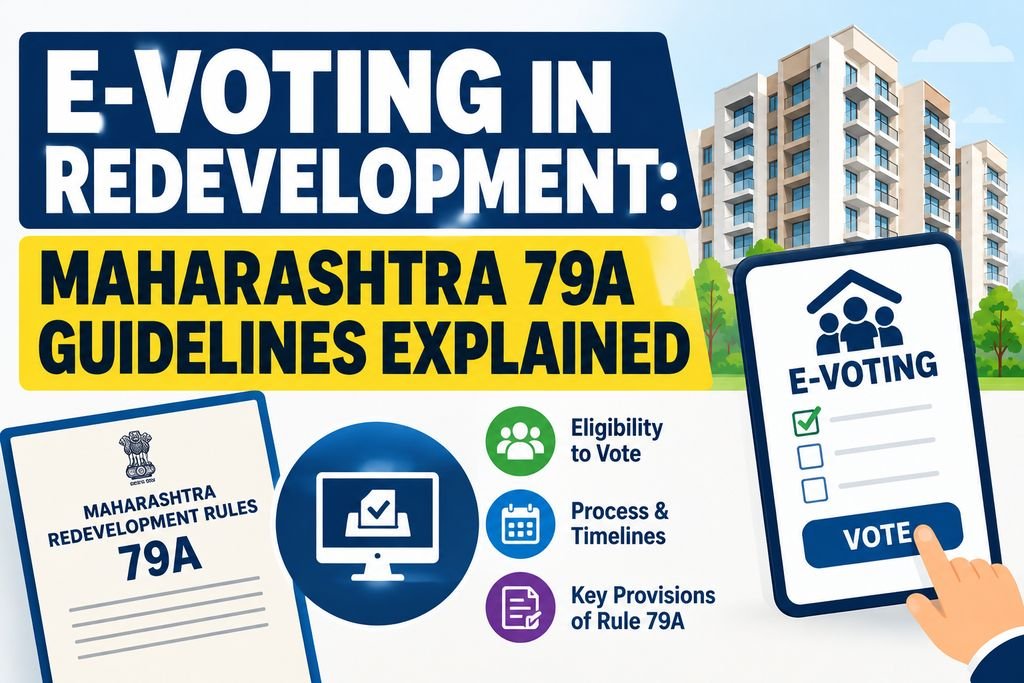
Housing society redevelopment is a significant decision that directly affects the rights, financial interests and future living conditions of every member. However, for large housing societies in Mulund, Mumbai, Thane, Pune and other parts of Maharashtra, conducting a special general body meeting (SGBM) to select a developer can be challenging, particularly when many members live outside the city or abroad.
A major difficulty is achieving the prescribed two-thirds quorum of the total membership for the meeting. This raises several important questions: Can a society conduct e-voting? Can members who cannot attend provide written consent? Does mock voting have any legal validity? Can a member change their preference when the final developer selection takes place?
These issues must be examined in the context of the Maharashtra Government’s redevelopment guidelines issued under Section 79A of the Maharashtra Co-operative Societies Act, 1960, particularly the Government Resolution dated July 4, 2019.
Maharashtra’s 79A Guidelines: Are They Mandatory?
The Government Resolution dated July 4, 2019, lays down a procedural framework for redevelopment of co-operative housing societies. It addresses various stages, from the society’s initial decision to undertake redevelopment to the appointment of a project management consultant (PMC), inviting developer proposals and selecting a developer.
An important legal question is whether these guidelines are strictly mandatory or merely directory in nature.
Judicial decisions have considered the legal status of the 79A redevelopment guidelines, and the position has often been discussed in terms of whether a particular procedural deviation invalidates the redevelopment process. However, the effect of a deviation depends on the applicable legal provision, the nature of the requirement and the facts of the case.
Even where a guideline is held to be directory rather than mandatory, it does not follow that a housing society can disregard the prescribed procedure altogether. A society should follow the applicable framework as closely as possible, maintain transparency and ensure that members receive a fair opportunity to participate in the decision-making process.
Any claim that a particular deviation is legally permissible should be assessed against the relevant judicial ruling and the precise facts involved.
Can a Housing Society Conduct E-Voting to Select a Developer?
For large housing societies, the requirement of physical attendance creates practical difficulties. Members may be living in another city, working overseas, travelling for employment or unable to attend because of age or health conditions.
Nevertheless, practical difficulty does not automatically create a legal right to vote through an alternative method.
Under the procedure described in the July 4, 2019, 79A redevelopment guidelines, the selection of a developer is conducted at a special general body meeting in accordance with the prescribed process. Where the applicable procedure requires members to be physically present for voting, a society should not assume that online voting or remote participation is valid merely because the technology is available.
Before introducing e-voting, the society must verify whether any subsequent Government Resolution, statutory amendment, binding court order or other applicable legal provision has authorised it for the particular redevelopment process.
The key distinction is between online participation as a practical facility and legally recognised voting. A video-conferencing facility does not, by itself, establish that an online vote is valid under the governing redevelopment procedure.
The State Government should consider a clear framework permitting secure online participation and voting, subject to appropriate safeguards. Such a framework could include verified member identities, secure voting records, confidentiality, prevention of duplicate votes and an auditable record of the result.
This would help large societies achieve meaningful participation without compromising the integrity of developer selection.
Can Individual Consent Letters Be Used to Achieve the 51% Majority?
Another question concerns members who cannot attend the special general body meeting. Can they sign consent letters supporting a particular developer, and can those letters be counted towards the majority required for selection?
A consent letter and a vote cast through the prescribed procedure are not necessarily legally equivalent.
Where the applicable 79A procedure requires developer selection to take place through voting at the special general body meeting, a society should not assume that letters collected beforehand from absent members can be added to the votes cast at the meeting.
A consent letter may record a member’s preference or opinion, but that alone does not establish that it qualifies as a valid vote for the statutory or guideline-based majority. The society must determine whether the applicable rules expressly recognise such a method.
The distinction is particularly important where the selection requires support from 51% of the total membership. The society must calculate the required majority using the applicable denominator and count only those votes or expressions of consent that are legally recognised for that purpose.
Consequently, a society should not use individual consent letters as a substitute for the prescribed voting process without a clear legal basis. Doing so could expose the selection process to objections and litigation.
What Is the Legal Validity of Mock Voting?
Some societies conduct mock voting before the formal developer-selection meeting. The purpose may be to understand members’ preferences, assess the likely outcome or identify the leading developer before the final meeting.
It is important to distinguish between an informal survey and the formal selection process.
Mock voting is not the same as the legally prescribed vote for selecting a developer. Unless the applicable legal framework specifically recognises a particular exercise as part of the formal process, mock voting should be treated only as an informal means of gauging members’ preferences.
A developer who receives the highest number of votes in a mock poll does not thereby acquire an automatic legal right to be appointed. Similarly, a society is not necessarily bound to select the front-runner of an informal exercise.
A letter identifying a developer as the society’s “preferred developer” should also not be confused with a final resolution passed through the prescribed procedure.
For transparency, societies should clearly communicate the purpose of any preliminary poll and state that its outcome is indicative only and does not replace the formal selection process. Members should be given access to the relevant proposals and sufficient information to make an informed decision at the formal meeting.
Can a Member Change Their Choice During the Final Selection?
A member may express a preference during a preliminary discussion or mock poll and later reconsider that preference after examining the competing proposals.
The legal significance of that change depends on the nature of the earlier exercise.
If the earlier exercise was only an informal mock poll, its result should not ordinarily be treated as a final vote or as an irrevocable commitment. A member’s preference in such a survey should not be confused with a vote validly cast during the formal selection process.
The final selection must be governed by the applicable procedure and the member’s valid vote at that stage. A society should not treat an informal preference as binding unless there is a specific and legally sustainable basis for doing so.
This is one reason why mock voting should be clearly separated from the formal developer-selection process. Confusing the two can create unnecessary disputes over whether a member was entitled to change their preference.
Why Is the Two-Thirds Quorum a Major Challenge?
For a large housing society, securing attendance from two-thirds of the total membership can be difficult. The problem becomes more pronounced when many members reside outside Mumbai or India.
The society must distinguish between the quorum required to commence the meeting and the majority required to approve the developer’s selection. These are separate requirements and should not be combined into a single calculation.
For example, a society with 300 members would need 200 members to meet a two-thirds quorum requirement, if that is the applicable rule. A separate majority requirement must then be calculated according to the relevant provision governing developer selection.
The society should not reduce the quorum or count absent members as present merely because achieving the prescribed attendance is difficult. Nor should it assume that written consent or online participation can be counted towards the quorum without legal authority.
Instead, the society should issue proper notices, circulate the developer proposals in advance, explain the voting procedure clearly and encourage members to attend the formal meeting. Where the required quorum cannot be achieved, the society should obtain advice on the procedure for adjournment and the requirements applicable to the subsequent meeting.
The Need for Transparent and Technology-Friendly Redevelopment Rules
Redevelopment decisions can involve substantial financial benefits, additional carpet area, transit accommodation, corpus payments and long-term obligations. It is therefore essential that developer selection is conducted through a process that is transparent, fair and legally defensible.
At the same time, redevelopment rules should account for the realities of modern housing societies. Many members no longer reside in the city where their property is located. Overseas residents, senior citizens and people with mobility restrictions may find physical attendance difficult even when they remain deeply interested in the redevelopment of their property.
The State Government should consider a clear legal mechanism for secure e-voting and online participation in redevelopment meetings. The framework should specify how members’ identities are verified, how quorum is calculated, whether remote participants count as present, how votes are recorded and audited, and how disputes are resolved.
Until such a mechanism is expressly authorised under the applicable law, societies should exercise caution and avoid assuming that electronic votes or consent letters can replace the prescribed formal procedure.
Conclusion
For housing societies undergoing redevelopment in Maharashtra, the central issue is not simply how to obtain the required majority, but how to obtain it through a legally valid and transparent process.
E-voting, consent letters, mock voting and the final developer-selection vote are distinct matters. A society should not treat them as interchangeable without verifying the applicable legal provisions and subsequent amendments or directions.
Mock voting may help assess members’ preferences, but it should not be confused with the formal selection of a developer. Similarly, consent letters from absent members should not automatically be counted as votes, and a member’s preliminary preference should not be treated as a binding final decision.
For a large society in Mulund or elsewhere in Maharashtra, the safest course is to follow the applicable redevelopment procedure, maintain complete records of notices and voting, and obtain specific legal advice before relying on an alternative method of participation. The State Government should also consider updating the framework to recognise secure electronic participation, making redevelopment more inclusive while preserving the rights of every member.